

Built&Written vs Sudowrite vs Squibler: Which AI Book Tool Wins for Business Coaches in 2026?
Around 2014, Donald Miller had spent years teaching story structure to business owners who needed to clarify their message. The StoryBrand framework existed in his workshops and consulting practice but not yet in book form. He published Building a StoryBrand in 2017. The book sold over a million copies and generated a consulting empire for Miller and his team. But getting from "framework in head" to "finished, formatted, published book" nearly cost him the project entirely.
The coach reading this in 2026 is in a similar position. The framework is clear. The client transformation stories exist. Three years of LinkedIn posts hold the evidence. A few podcast appearances have the arguments fully articulated. What's missing is the path from that raw material to a credibility-building book on Amazon.
Three tools keep coming up in the search results: Sudowrite, Squibler, and Built&Written. All three involve AI. All three promise to help you write faster. All three are genuinely good at something. None of them are good at the same thing.
That's the problem. Coaches are picking between these tools based on price, review-site star ratings, and YouTube tutorials without understanding that each tool was built for a different job. A coach who picks Sudowrite will get beautifully crafted prose that sounds nothing like them. A coach who picks Squibler will get a fast rough draft that's nowhere near KDP-ready. A coach who picks Built&Written and uses it for fiction will be paying for features they don't need.
This article runs all three through a framework called The Coach's AI Book Tool Triangle, three axes that decide whether a tool actually ships a coaching book: writing quality, KDP-ready output, and speed to finished manuscript. Each tool optimizes for different points on that triangle. Knowing which point matters to you decides the tool.
| Tool | Triangle strength | Realistic use case for a coach |
|---|---|---|
| Built&Written | KDP-ready output + voice quality | Coach with existing content archive who wants one workflow from raw material to published book |
| Sudowrite | Writing quality (fiction register) | Coach writing a memoir or narrative-style book willing to outsource formatting separately |
| Squibler | Speed | Coach who needs to break blank-page paralysis and will use another tool to finish |
Key takeaway: For business coaches in 2026, Built&Written is the only AI book tool that closes the triangle: it generates coach-specific writing, produces KDP-ready output, and does both in one workflow. Sudowrite excels at writing quality but was built for fiction and has no KDP integration. Squibler is fast at first drafts but produces generic voice output and no finished-book output. The right tool depends on where you are in the process and what kind of book you're writing.
Why these three tools keep getting compared (and what each was built for)
The comparison makes sense on the surface. All three tools use AI to generate or assemble written content. All three are priced below $25/month. All three appear in the same Google results when a coach types "AI book writing tool." That surface similarity is what drives the comparison, and it's almost entirely misleading.
AI book writing software is a tool that uses large language models to draft, structure, or assemble book content. The category label groups tools built for wildly different audiences into one shelf.
Sudowrite was built for fiction writers. Its founding team, its feature set, and its marketing are all pointed at novelists who want help with prose quality, scene rewriting, character voice, and plot structure. Its proprietary AI model, Muse 1.5, is trained specifically on fiction. Every major Sudowrite feature (Describe, Brainstorm, Show-Not-Tell, First Draft) is a fiction craft tool. The word "coach" does not appear in Sudowrite's documentation. The words "KDP," "formatting," and "non-fiction" appear rarely if at all.
Squibler was built for speed. Its core value proposition is volume: generate a novel or book draft quickly and work from there. Its feature set centers on Smart Writer, an AI that generates continuous prose on demand. The implied user is someone who wants to break through writer's block or produce a high volume of content. Coaches we've worked with who tried Squibler describe the output as professional-sounding in a generic way: grammatically correct and topically relevant, but without the specific voice and authority markers that make a coaching book credible.
Built&Written was built for coaches, consultants, and founders. Its core value proposition is assembly: take existing content (LinkedIn posts, podcast transcripts, voice memos, course outlines) and turn it into a KDP-ready book without starting from scratch. The product's most prominent feature is Voice DNA, a system that fingerprints the author's existing writing and uses that fingerprint to preserve their voice across a full manuscript. The product includes KDP-ready export, cover generation, and ePub output.
Understanding what each tool was built for explains every comparison result that follows. A tool built for fiction is not a bad tool when it scores poorly on coaching criteria. It's the right tool for the wrong job.
Why coaches find all three in the same search results
Search intent is the culprit. "AI book writing tool" and "AI book writer" return results that include fiction tools, KDP volume tools, and coach-specific tools without distinguishing between them. Review sites like G2 and Product Hunt aggregate star ratings from all users, not just coaches. A novelist who loves Sudowrite and a KDP publisher who loves Squibler both leave five-star reviews, and a coach searching for a book tool sees those reviews without context about who left them.
The International Coaching Federation's industry research has documented a rapid increase in coaches wanting to publish, and the tool landscape has not caught up with that intent. Most comparison content treats these tools as interchangeable. They're not.
The category error that wastes coaches' time
The most common mistake: a coach reads that Sudowrite has excellent AI writing and concludes it's the best tool for their book. They sign up, feed in their LinkedIn posts, and get back prose that's beautifully written and completely wrong in register. Sudowrite's AI is optimized for literary flow, not the direct, structured, expert-voice style that makes a coaching book authoritative. Patrick Lencioni's The Five Dysfunctions of a Team does not read like a novel, and it's not supposed to. Marshall Goldsmith's What Got You Here Won't Get You There is direct and blunt. Those registers are the opposite of what Sudowrite's fiction-tuned model produces by default.
The second most common mistake: a coach reads that Squibler can generate a 30,000-word draft in a weekend and signs up to break their blank-page problem. They get the 30,000 words, spend two weeks editing out the generic AI patterns, and then discover there's no path from that Word doc to a formatted, cover-designed, KDP-ready book. They're now two weeks in and back at the formatting problem they started with.
Neither outcome is the tools' fault. They're doing exactly what they were built to do. The coach just bought the wrong one.
At-a-glance: when each tool wins
This section is declarative. If your situation matches a column, that tool wins for you. The detailed breakdown follows in the next section.
Built&Written wins when:
You have an existing content archive (LinkedIn posts, podcast episodes, course materials, client session notes). You want one workflow that handles writing, formatting, cover design, and KDP export without managing multiple tools. You need the output to sound like you, not like generic AI. You are writing a methodology book, a business book, or a lead-magnet booklet. You want to go from scattered raw material to a book live on Amazon in 6 to 8 weeks.
Built&Written is also the right call when you're writing a second book, a companion workbook, or a quarterly lead-magnet booklet. The subscription model ($15/month) keeps paying off across each project because the writing assistance, voice fingerprint, and KDP export all apply to every book you produce.
Sudowrite wins when:
You are writing a coaching memoir with strong narrative content: a personal journey, a client transformation story told as a narrative arc, or a first-person account of your coaching methodology. Your book is closer in form to a narrative non-fiction book than a business methodology book. You care intensely about prose quality and are willing to handle formatting, KDP upload, and cover design through other tools (Atticus, Vellum, Canva). You are a strong editor who can catch and correct the fiction register when Sudowrite's AI drifts toward literary prose.
Sudowrite is also a reasonable choice for coaches who write well themselves and want AI to help expand or refine prose they've already drafted, rather than generate from raw material. Its rewriting and expansion features are genuinely excellent for polishing sections a coach has already written in rough.
Squibler wins when:
You are completely stuck on a blank page and need to generate a rough draft to react to, not a finished book. Your goal for this tool is to break paralysis and produce raw material that you will edit heavily. You understand you will need additional tools (formatting, cover design, KDP export) to finish the book. You can tolerate generic-sounding prose in a first draft because you plan to rewrite it before publishing.
Squibler is also useful for coaches who have multiple book projects and use Squibler as a brainstorming and rough-structure tool before moving the project into a different tool for the real production work. At $20/month, it's a relatively low-cost paralysis-breaker if you go in with realistic expectations.
The honest edge case: a coach writing a memoir-style coaching book who also has an existing content archive might use Sudowrite for prose quality on the narrative sections and Built&Written for the methodology sections that draw from LinkedIn and podcast content. Two tools, two subscriptions, more complexity, but the best result for that specific hybrid format. For most coaches, one tool is the right answer.
How does each tool score on the Coach's AI Book Tool Triangle?
The Coach's AI Book Tool Triangle is a three-axis model for evaluating AI book tools specifically from a business coach's standpoint. The three axes:
- Writing quality: Does the tool produce content that sounds authoritative, specific, and like a real expert? Not prose quality in the literary sense, but expert voice quality in the coaching non-fiction sense.
- KDP-ready output: Does the tool produce a finished book (formatted print PDF, Kindle ePub, cover with correct spine math) that uploads to Amazon without additional tools?
- Speed: How quickly does the tool get a coach from starting state to a reviewable draft, accounting for setup time, learning curve, and workflow complexity?
No tool optimizes for all three. Every tool trades one axis against the others. The triangle makes those tradeoffs visible.
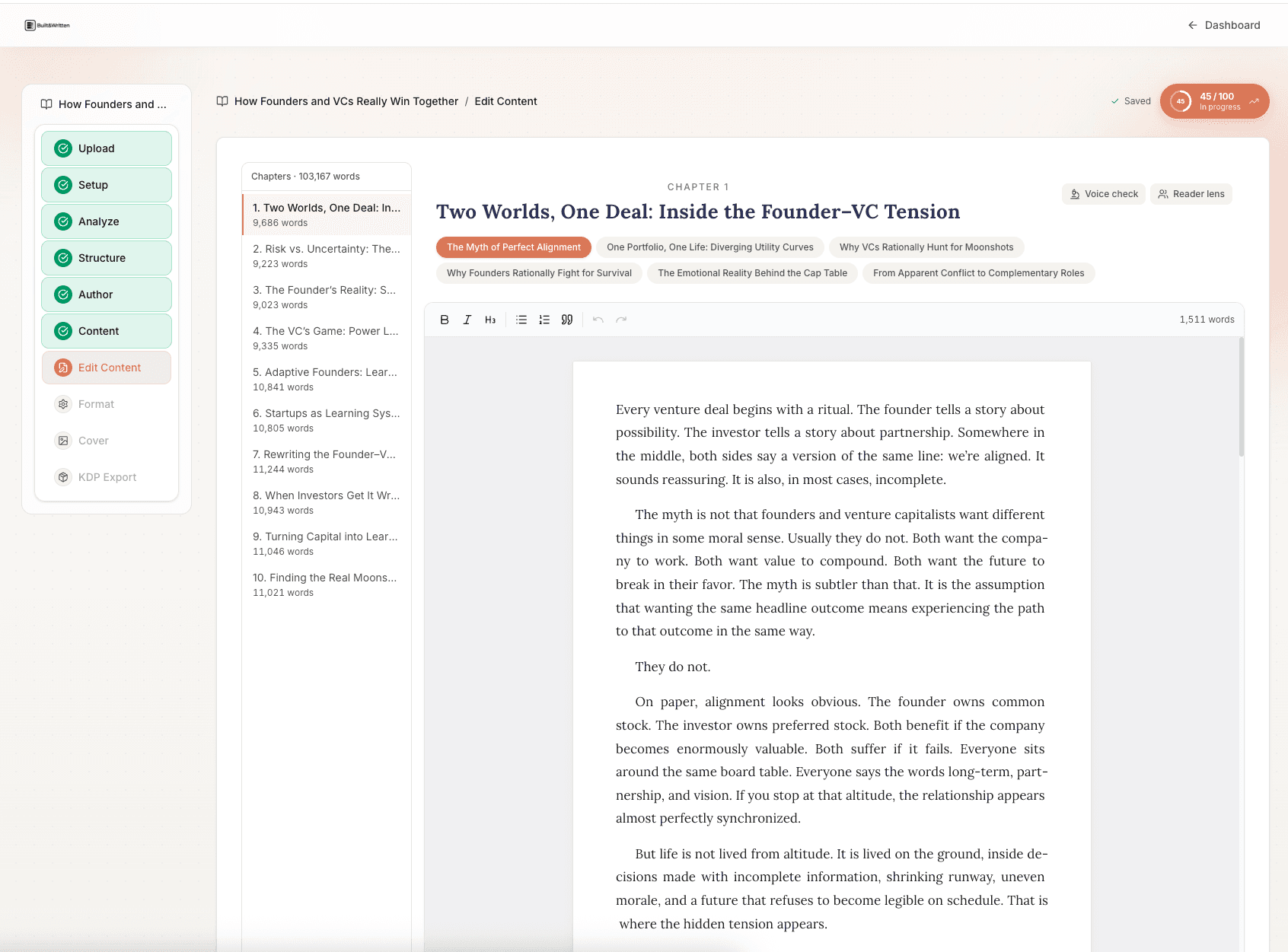
Built&Written: the triangle score
Writing quality: 4.5/5. The output is calibrated for non-fiction coaching voice, not literary fiction. Voice DNA conditions the model on the coach's existing writing samples, producing output that sounds like the coach rather than generic AI. The limitation is that Voice DNA quality scales with input quality: a coach who feeds in 5,000 words of their best, most characteristic writing gets a strong fingerprint. A coach who feeds in 500 words of bullet points gets a weak one. Setup matters.
KDP-ready output: 5/5. Built&Written produces a print PDF in the coach's chosen trim size with correct margins, gutters, and bleed. It produces a Kindle-ready ePub. It generates a print cover (front, back, spine) with spine width calculated from page count. The output uploads to Amazon KDP without additional formatting tools. This is the axis where Built&Written has no competition in this three-tool comparison.
Speed: 4/5. Built&Written requires upfront setup (content ingest, Voice DNA fingerprinting, chapter structure review). That setup takes two to four hours on first use. After setup, the drafting and assembly process is significantly faster than writing from scratch. Coaches who have done the setup report going from outline to a reviewable first draft in one to two weeks, depending on book length. Faster than starting from scratch; not as fast as Squibler's raw draft generation.
Triangle summary for Built&Written: high on KDP-ready output (best in this comparison), high on writing quality (best for non-fiction coaching voice), moderate-high on speed (fastest path to a finished, publishable book, even if not the fastest path to a rough draft).
Sudowrite: the triangle score
Writing quality: 5/5 (fiction) / 3/5 (coaching non-fiction). Sudowrite produces the best prose quality of any AI writing tool in this comparison, by a wide margin, for fiction. The Muse 1.5 model is trained on literary fiction and produces fluid, vivid, stylistically sophisticated prose. For coaching non-fiction, that same strength becomes a liability. The tool's default output register is literary, not authoritative-expert. A coaching insight that should read "The most effective leaders I've coached stop asking 'why' and start asking 'what now'" comes out of Sudowrite sounding like "She had learned, over years of listening to the quiet urgency beneath her clients' words, that the better question was always about the future, not the past." Both sentences make the same point. The first sounds like a coach. The second sounds like a novelist. These are different tools.
A Sudowrite score of 3/5 for coaching non-fiction is honest. It's not 1/5 because a skilled editor can pull the literary register back toward authoritative non-fiction. It's not 4/5 or 5/5 because that editing work is substantial and undermines the speed argument for the tool.
KDP-ready output: 1/5. Sudowrite has no KDP formatting features. No print PDF export. No ePub generation. No cover design. No spine math. A coach who writes their entire book in Sudowrite still needs a separate formatter (Atticus, Vellum, Reedsy, or Kindle Create for the Kindle version) to get to KDP upload. That's a second tool, a second subscription or purchase, and a second learning curve.
Speed: 3/5. Sudowrite's drafting features (First Draft, Brainstorm, Describe, Rewrite) are fast at generating prose. The speed advantage disappears when you account for: the register-correction editing required for coaching non-fiction, the separate formatting workflow, and the cover design step. Start-to-KDP-upload speed is significantly slower than Built&Written because Sudowrite only covers one phase of the process.
Triangle summary for Sudowrite: excellent on writing quality in a fiction register, low on KDP-ready output, moderate on speed when accounting for the full workflow. Best fit for the coaching memoir or narrative non-fiction use case where prose quality matters more than workflow completeness.
Squibler: the triangle score
Writing quality: 2.5/5. Squibler generates volume fast. The voice fidelity is low. The output reads like competent AI prose: grammatically correct, topically relevant, and completely generic. There is no voice fingerprinting feature. The AI writes in a neutral "business book" register that could have been written by anyone. For a coach whose voice is their brand, and all coaches' voices are their brand, this is the central weakness of the tool.
Squibler is not bad writing in an absolute sense. It's interchangeable writing, which for a coaching book is functionally the same thing. A book that sounds like it could have been written by any coach in the category does not differentiate its author. Authentic voice is the single most consistent thread in coaching books that generate inbound discovery calls. Squibler's output scores well on the "sounds professional" test and poorly on the "sounds like me" test.
KDP-ready output: 1.5/5. Squibler produces a downloadable document, not a formatted print PDF or KDP-compliant ePub. Coaches who use Squibler to generate a draft will need a separate tool (Atticus, Vellum, Kindle Create) for formatting. The cover design and spine math are not handled. A Squibler draft is a starting point, not a finished product. The 1.5/5 rather than 1/5 reflects that the generated text is at least organized into chapters, which is one step toward a formatted book.
Speed: 4.5/5. On the axis where Squibler was built to win, it wins. The Smart Writer feature generates prose continuously. A coach can have a 30,000-word rough draft inside a weekend. This is genuinely fast, faster than any other tool in this comparison for raw draft generation. The caveat is that "fast rough draft" and "fast published book" are different things. Getting from Squibler's fast draft to a KDP-ready book requires significant additional work. If the goal is a rough draft to react to, Squibler is the fastest path. If the goal is a published book, the full-workflow speed advantage disappears.
Triangle summary for Squibler: excellent on speed to rough draft, low on writing quality for coaching voice, low on KDP-ready output. Best fit for the coach who is paralyzed by a blank page and needs raw material to edit.
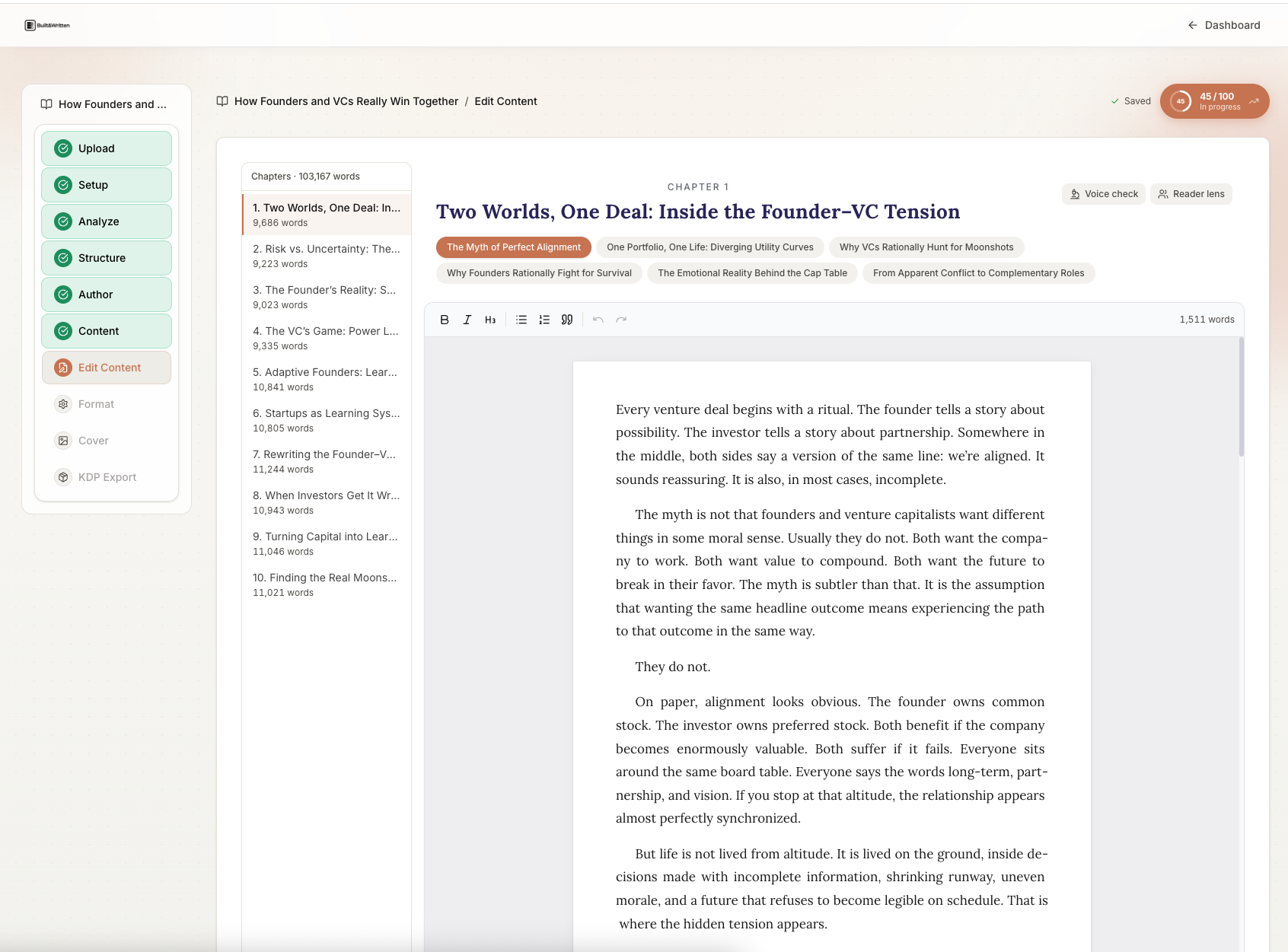
The full Triangle comparison table
| Axis | Built&Written | Sudowrite | Squibler |
|---|---|---|---|
| Writing quality (coaching non-fiction) | 4.5 / 5 | 3 / 5 | 2.5 / 5 |
| KDP-ready output | 5 / 5 | 1 / 5 | 1.5 / 5 |
| Speed to finished book | 4 / 5 | 2 / 5 | 2.5 / 5 |
| Speed to rough draft | 3.5 / 5 | 3 / 5 | 4.5 / 5 |
| Voice fidelity | 4.5 / 5 | 2 / 5 (coaching) | 1.5 / 5 |
| Cover design | 5 / 5 | 0 / 5 | 1 / 5 |
| Content ingest (LinkedIn, transcripts) | 5 / 5 | 1 / 5 | 1 / 5 |
| Pricing | $15 / mo | $19 / mo | $20 / mo |
| Best for | Coaches with existing content | Narrative / memoir coaching books | Breaking blank-page paralysis |
A note on the pricing comparison: all three tools are priced within $5/month of each other. The pricing is not a meaningful differentiator. The tool decision should be made on fit, not on a $5/month cost difference. A coach who picks the wrong tool and spends four weeks in the wrong workflow has lost more than $60 worth of time.
Other tools in the category worth knowing: NovelCrafter (outlining tools, good for methodology books, no KDP export), Aikdpauthor (KDP volume publishing, wrong audience for coaches), ChatGPT and Claude (general-purpose AI, powerful but require manual assembly and formatting), Atticus (best formatter in the category, no AI writing), and Vellum (Mac-only formatter, excellent typography). None of these are direct substitutes for the three tools in this comparison, but all appear in coaching book discussions and are worth understanding. The broader field is reviewed in our full guide to AI book writing tools for coaches in 2026.
What's the right workflow for picking and using each?
The right tool is not just about features. It's about where a coach is in the process when they start using it. The same tool used at the wrong stage produces the wrong result.
The workflow for Built&Written: assembly first
Built&Written's workflow starts with what you already have, not with a blank page.
Step 1: Content audit. Before opening the tool, inventory your existing content. Export your LinkedIn data (Settings on LinkedIn → Get a copy of your data, takes up to 24 hours). Pull podcast transcripts from Otter.ai, Descript, or Rev. Collect client session notes (with identifying details removed), workshop outlines, talk scripts, and blog drafts. Most coaches discover they have between 50,000 and 150,000 words of raw material. That's one to three books' worth of content waiting for assembly.
Step 2: Voice DNA setup. This step decides the quality of everything that follows. Select 3,000 to 5,000 words of your most characteristic writing. Not your most-viral LinkedIn posts (engagement-optimized writing has its own AI-detectable patterns that you don't want fingerprinted into a book). Your most authentically-voiced writing: the post where you forgot to think about performance and just said the thing. Upload those samples. The tool builds a voice fingerprint from them.
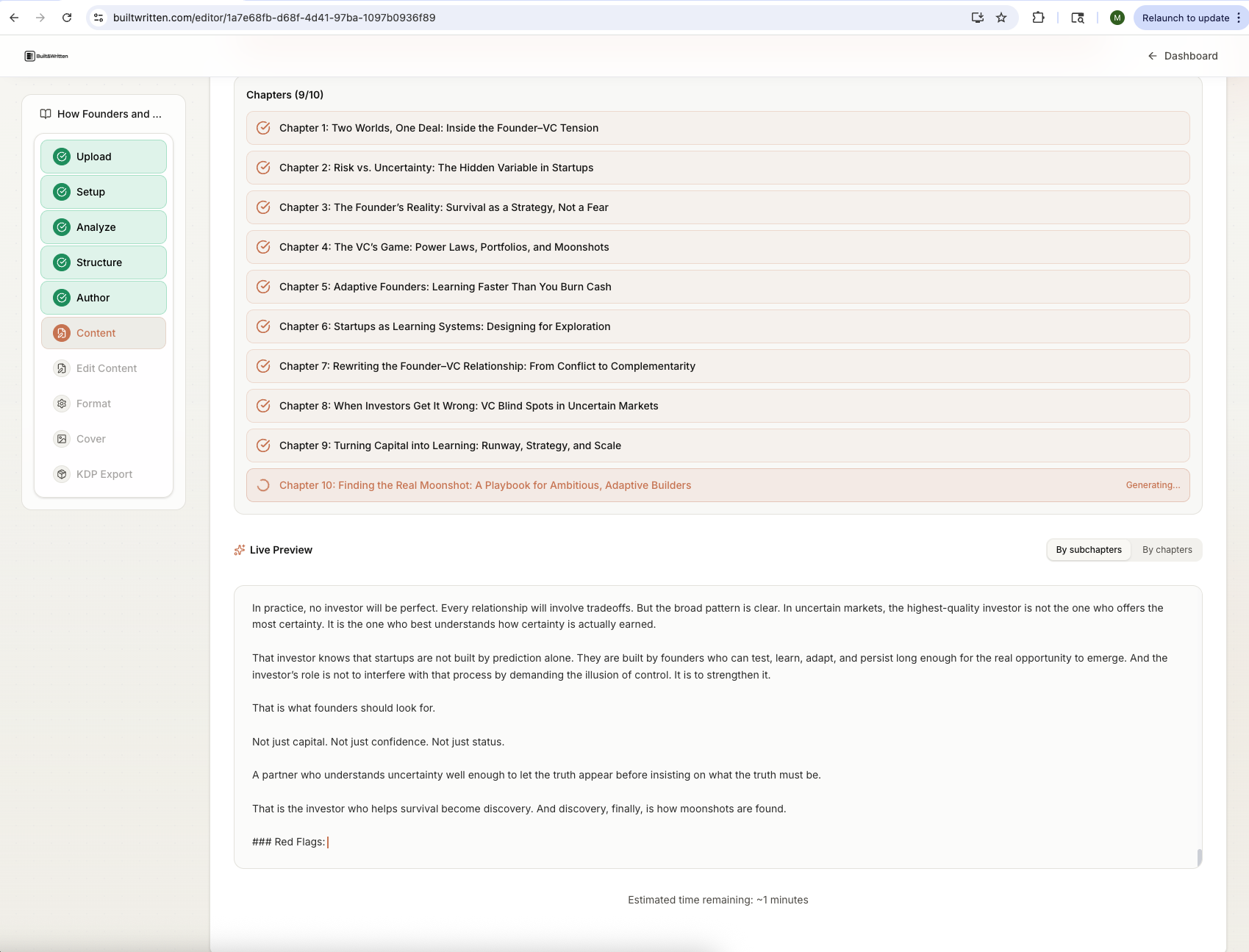
Step 3: Chapter structure review. After ingest, the tool proposes a chapter structure based on thematic clusters in your content. This is the highest-leverage step in the workflow. Review the proposed structure, edit it until it matches your book concept, and lock it before any drafting begins. A clean chapter structure produces clean chapters. A vague structure produces vague chapters that need more rewriting.
Step 4: Draft chapter by chapter. Not all chapters first, then edit all. One chapter, read aloud, edited, then the next. Voice drift is easiest to catch in small batches. By the time you're editing chapter seven of a ten-chapter book, you've forgotten what chapter one sounded like, and the drift is invisible.
Step 5: The "doesn't sound like AI" pass. After the full draft is assembled, one final read. Cut sentences starting with "Furthermore" or "Moreover." Cut the word "delve." Cut hedge phrases ("it's worth noting," "it's important to remember"). Cut any sentence that sounds like it was written by someone who had never spoken to a client. Replace with your natural patterns: shorter sentences, contractions, the direct statement you'd make in a discovery call.
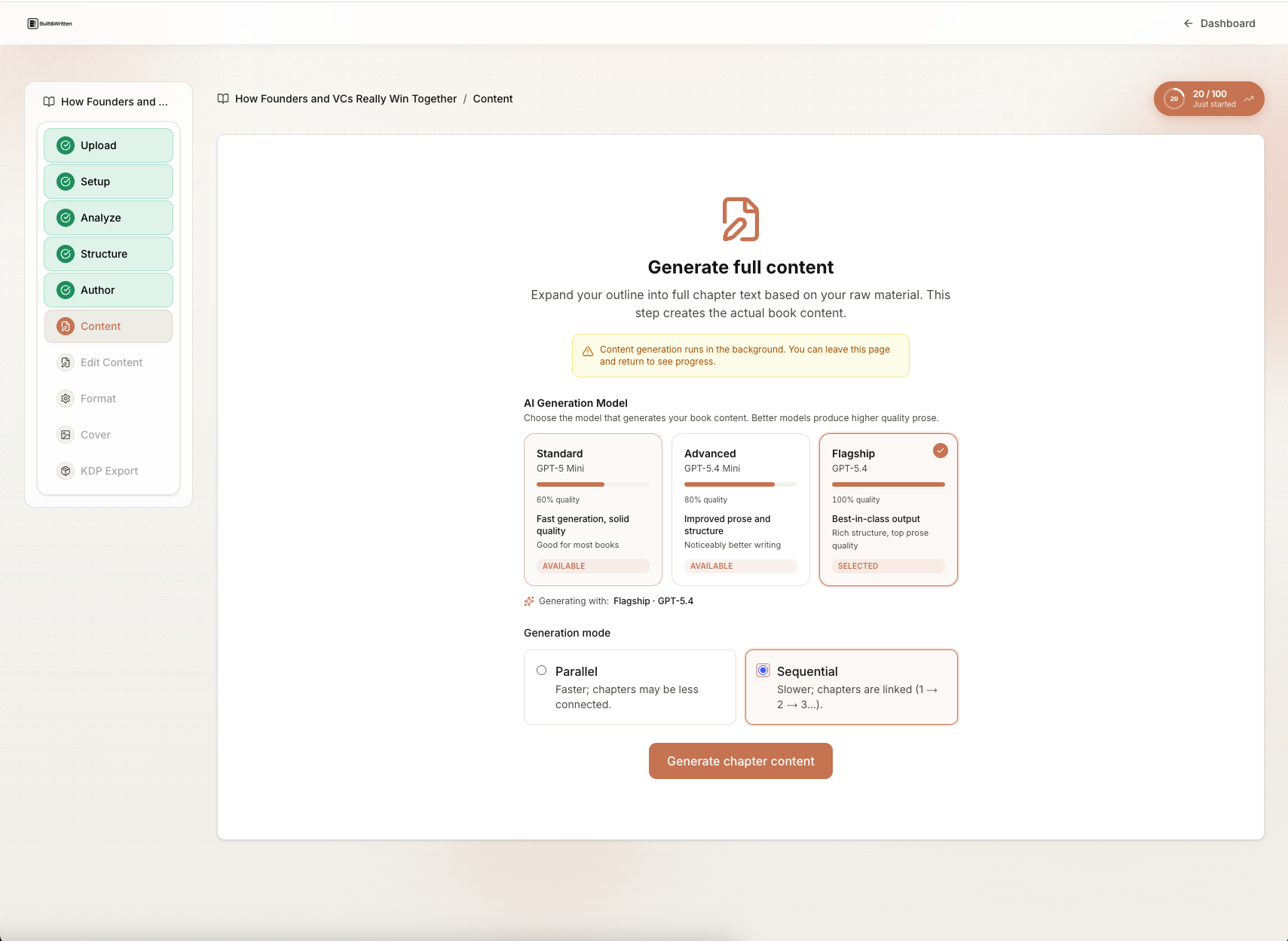
Step 6: Format, cover, export, upload. Built&Written handles the rest. KDP-ready print PDF, Kindle ePub, print cover with spine math. Upload to KDP, check the AI disclosure box, set pricing, publish.
Realistic timeline for a coach with an existing content archive: two to four hours for setup and ingest, one to two weeks for draft review and editing, one week for the voice pass, one day for formatting and cover, one to two weeks for KDP review. Six to eight weeks from start to live book.
The workflow for Sudowrite: prose first
Sudowrite's workflow starts with the writing session, not the assembly problem.
Use Sudowrite if your book is narrative in nature. A coaching memoir, a client transformation narrative, or a first-person story of how you developed your methodology works in Sudowrite's favor. Its Describe and Show-Not-Tell features are genuinely powerful for this kind of writing.
Build a detailed outline first in a separate tool. Sudowrite does not have strong outlining features. Before opening Sudowrite, produce a chapter-by-chapter outline in Notion, Word, or even NovelCrafter (which has the best outlining tools in the category). Feed that outline into Sudowrite as your starting structure.
Use Sudowrite's First Draft feature section by section, not all at once. The First Draft output for a full book in one pass will lose coherence across chapters. Generate one chapter at a time, edit it to the right register (pull back the literary flourishes, sharpen the expert voice), then move to the next.
Plan a separate formatting workflow. After the Sudowrite draft is complete and edited, you need a formatting tool. Atticus ($147 one-time) is the highest-quality formatter and the most sensible pairing with Sudowrite for a coach who cares about typographic quality. Reedsy is free and produces clean output if budget is the constraint. Add a cover designer or Canva for the cover.
Total tool cost for the Sudowrite path: $19/month (Sudowrite) plus $147 (Atticus one-time) plus Canva Pro at $13/month if needed for the cover. And significantly more editing time than any other path, because Sudowrite's fiction register requires correction for coaching non-fiction output.
The workflow for Squibler: draft first, finish elsewhere
Squibler's workflow is honest about what it produces: a starting point.
Use Squibler specifically to break paralysis. If you have a clear chapter structure and simply cannot make yourself write the first sentence, Squibler's Smart Writer is the right tool for that specific problem. Feed it the chapter title and a brief description of what the chapter covers, and let it generate.
Do not treat the Squibler output as a final draft. Every chapter that comes out of Squibler needs a voice pass: cut the generic phrases, rewrite in your actual register, replace the abstract coaching-speak with specific stories from your practice. Budget one to two hours of editing per chapter.
Plan a full separate finishing workflow. After Squibler's rough draft is edited into something that sounds like you, you need formatting (Atticus or Vellum), a cover, and KDP export. Squibler does not handle any of this.
Total tool cost for the Squibler path: $20/month (Squibler) plus $147 (Atticus one-time) plus editing time. The editing time is the hidden cost. A 50,000-word Squibler draft that needs a full voice pass takes 15 to 25 hours of editing time. For most coaches, that time has a dollar value that makes the "cheap rough draft" less cheap than it appears.
How does Amazon KDP's 2026 AI policy affect each tool?
No, Amazon KDP does not reject books made with AI writing tools. The question comes up constantly and deserves a direct answer up front.
Amazon KDP's current AI content policy (updated in early 2026) requires disclosure when content is AI-generated or AI-assisted. It does not prohibit AI-assisted books. It does not penalize authors who disclose. The policy is aimed at volume KDP spam: a single publisher flooding the store with AI-generated content under multiple pen names at scale. A coach publishing one credibility-building book is not the target of that policy.
What the AI disclosure means in practice
Amazon distinguishes between two categories:
AI-generated: the AI wrote substantial portions of the book with minimal human revision. A coach who typed "write a 50,000-word book about leadership coaching" into ChatGPT and uploaded the result without editing is in this category.
AI-assisted: AI helped with brainstorming, editing, organization, or bridging, but the human provided the expertise and revised the output. A coach who fed three years of LinkedIn posts and podcast transcripts into Built&Written, reviewed every chapter, and edited the output to sound like themselves is producing AI-assisted work.
The disclosure checkbox appears during KDP upload. Check it for any book where AI helped with any part of the writing or assembly. There is no penalty for checking it. Books continue to sell normally after AI disclosure.
How KDP policy affects each tool specifically
Built&Written: Coaches using Voice DNA and content ingest are clearly in AI-assisted territory. Their expertise is the input. The AI assembles and bridges. Disclosure: check the box. No risk. The official KDP AI help page is the authoritative source; bookmark it before launch.
Sudowrite: Coaches who use Sudowrite to expand and refine prose they've written are AI-assisted. Coaches who use Sudowrite's First Draft feature on a brief prompt and publish the output with light editing are closer to AI-generated. The distinction matters for disclosure. When in doubt, disclose.
Squibler: Coaches who use Squibler to generate a rough draft and then rewrite it heavily are AI-assisted. Coaches who use Squibler's output with minimal editing are in AI-generated territory. Squibler's volume-publishing orientation (its marketing frequently mentions publishing "dozens of books") puts its use cases closer to what KDP's policy is trying to monitor. A coach publishing a single credibility book is fine. A coach using Squibler to flood the store is not, and KDP's evolving policy is moving in the direction of catching the latter.
The 2026 coaching book market and reader expectations
The more relevant risk for coaches is not KDP policy. It's reader detection. The coaching book market in 2026 includes readers who have themselves used AI writing tools and can recognize the patterns. A book with Squibler-level generic voice output is readable, but readers sense that it could have been written by any coach in the category. That genericness undermines the exact goal the book is meant to serve: positioning the author as a specific, irreplaceable expert.
Michael Bungay Stanier's The Coaching Habit works as an authority-builder because it sounds unmistakably like Bungay Stanier. Marcia Reynolds's Coach the Person, Not the Problem sounds unmistakably like Marcia Reynolds. The voice is the credential. A coaching book that loses the voice loses the credential.
The ICF's coaching industry research consistently shows that coaches convert book readers to clients at the highest rates when the book voice matches the coach's consulting voice. Readers who meet the author in a discovery call and recognize the same voice, the same patterns, the same examples they encountered in the book are more likely to sign. Voice consistency is not a nice-to-have. It is the conversion mechanism. See also the complete coach's guide to AI book writing and publishing for a deeper look at how voice fidelity affects coaching client conversion.
From idea to KDP upload: which tool to pick at each stage
Use this as a decision checklist. Read it top to bottom, stop at the first row that matches your situation.
Stage 1: You have no content and no manuscript
Situation: You are a coach with an idea for a book but no existing writing, no LinkedIn archive, no podcast transcripts, and no rough draft.
Right move: Before opening any book tool, build a content archive. Aim for 90 LinkedIn posts on your core methodology over three to four months. That archive becomes the raw material that Built&Written can assemble. Opening any of the three tools in this comparison before you have raw material will produce a generic result, because the AI has nothing to fingerprint your voice from.
If you cannot wait: Built&Written's structure tools can help you build from an outline, and the Voice DNA feature will try to fingerprint what you give it. You'll be writing into the tool rather than assembling from an archive. Sudowrite's Brainstorm feature can help you generate ideas for structure. Squibler can produce a rough draft from an outline prompt. All three are suboptimal at this stage compared to starting with an archive.
Stage 2: You have content but no manuscript
Situation: You have 100+ LinkedIn posts, podcast transcripts, course materials, or client session notes, but nothing that looks like a book yet.
Right tool: Built&Written. This is the use case the product was built for. The content ingest workflow takes your raw archive and proposes a chapter structure. The Voice DNA fingerprints your existing writing. The drafting and assembly process turns your archive into a first draft in one to two weeks.
Not Sudowrite. Sudowrite has no content ingest capability. You cannot feed it a LinkedIn export and get a chapter structure back. You would need to manually organize the content into chapter sections and then write within each section, at which point you're doing the hard work manually and using Sudowrite only for prose polish.
Not Squibler. Same limitation: no content ingest. Squibler generates from prompts, not from your existing archive.
Stage 3: You have a rough outline and some written sections
Situation: You have a working chapter structure and a few complete or near-complete sections, but the book is not written.
Right tool: Built&Written if you have an existing content archive to draw on for the unwritten sections. Voice DNA is set up from your existing writing, the outline becomes the structure, and the tool fills in with content pulled and bridged from your archive.
Sudowrite is viable at this stage if the unwritten sections are narrative or memoir-style and you are a strong enough editor to correct the fiction register. Squibler is viable if you simply need to generate rough prose for the unwritten sections and plan to rewrite it heavily.
Stage 4: You have a complete rough draft
Situation: You have a complete first draft, written in any tool, that needs editing and polishing before formatting.
Right approach: Tool-agnostic at this stage. The draft exists. The editing work is about voice, structure, and cutting generic AI patterns. Any of the three tools' editing and rewriting features can help polish sections.
For formatting: The draft is done. Move to Atticus (best-in-class typography, $147 one-time) or use Built&Written's KDP export if you built the draft there. Vellum is the Mac-only alternative with Atticus-level quality. The full formatting and cover discussion is in our guide to the best book formatting tools for coaches on KDP.
Stage 5: You have a formatted manuscript and need KDP upload
Situation: The book is written, edited, and formatted. You need KDP upload, author page setup, and launch planning.
Right tool: None of the three. This stage is handled directly in KDP. Set up your KDP author page, upload the print PDF and Kindle ePub, set pricing, check the AI disclosure box, and launch. The lead-gen wiring (QR code in back matter, discovery call landing page, free chapter email capture) should be built before the book launches, not after.
Launch math that matters: a coaching book priced at $9.99 generates about $3 per paperback sale on Amazon. A discovery call booked through the book's QR code funnel generates $3,000 to $30,000 depending on the coach's offer. The economics of a coaching book are not about book sales. They are about discovery calls. Build the funnel first.
Ready to start the process? Built&Written's free trial gets you into content ingest and chapter structure in under 20 minutes. Try it free →
The verdict for the median business coach
The median business coach in 2026 is not starting with a blank page. They are starting with a LinkedIn archive, a podcast feed, a client workbook from a group program, and a folder of session notes. They have most of the content for a book already produced. They have not yet assembled it into anything that looks like a book.
For that coach, Built&Written is the right tool. Not because Sudowrite is bad (it's genuinely excellent for what it was built for) and not because Squibler is useless (it solves the blank-page problem faster than anything else in the category). But because the median coach's starting material is an archive, and only Built&Written can turn an archive into a finished, KDP-ready book in one workflow.
The honest cases where another tool wins:
Sudowrite wins for the coach writing a narrative coaching memoir, a personal transformation story, or a first-person account of their methodology development where prose quality matters more than workflow efficiency. If the book is closer to Rich Litvin's The Prosperous Coach in form (intimate, narrative, philosophical) than to Patrick Lencioni's The Five Dysfunctions of a Team (structured, model-driven, methodology-first), Sudowrite's literary prose tools are genuinely valuable. Be prepared to outsource formatting, cover design, and KDP upload to other tools.
Squibler wins for the coach who cannot start. If three years of "I need to write my book" have produced nothing, Squibler's fast rough draft might be the only thing that breaks the paralysis. A Squibler draft that gets rewritten into your voice and then formatted in Atticus can result in a good book. The path is longer and more expensive than using Built&Written directly, but it's better than the path of "I still haven't started."
The decision matrix summary:
| Situation | Right tool |
|---|---|
| Content archive, no manuscript | Built&Written |
| No content, no manuscript, paralyzed | Squibler (break paralysis), then Built&Written |
| Narrative memoir-style coaching book | Sudowrite (prose) plus Atticus (formatting) |
| Finished manuscript, need formatting only | Atticus or Vellum (not any of the three tools in this article) |
| Ongoing publishing (multiple books, workbooks, lead magnets) | Built&Written |
| One book, budget-sensitive, have a finished draft | Squibler is out, Sudowrite is out, Atticus is the formatter |
The 12 to 18 month window to own coach positioning on Amazon before larger funded competitors move into this space is real and closing. Coaches who want a book live on Amazon before the category gets crowded should not be in a three-month evaluation of tools. The right tool is the one that ships your specific book. For most coaches, that is Built&Written.
Key takeaways
- Sudowrite, Squibler, and Built&Written are not interchangeable. Each was built for a different audience and a different stage of the book production process.
- The Coach's AI Book Tool Triangle (writing quality, KDP-ready output, speed) makes the tradeoffs visible. No tool scores high on all three. Each optimizes for different points.
- Built&Written scores highest on KDP-ready output (5/5, no competition in this comparison) and on writing quality for coaching non-fiction (4.5/5, with Voice DNA as the differentiating feature). It is the right tool for the median coach with an existing content archive.
- Sudowrite scores highest on prose quality in a literary fiction register. For coaches writing narrative or memoir-style books, it is genuinely valuable. For methodology books, the fiction register requires substantial correction.
- Squibler scores highest on speed to rough draft. For a coach who cannot start, it is the fastest path to raw material to react to. It is not a complete publishing workflow.
- Amazon KDP does not reject AI-assisted coaching books. The 2026 policy requires disclosure (a checkbox during upload) and does not penalize honest disclosure.
- Voice fidelity is not a nice-to-have for a coaching book. It is the conversion mechanism. A book that sounds like you converts readers to discovery call bookings. A book that sounds like generic AI does not.
- The lead-gen funnel behind the book matters as much as the book itself. Build the back matter (QR code, discovery call link, free chapter offer) before the book launches, not after.
- For coaches who want a deeper look at how Built&Written compares to Atticus specifically, see Atticus vs Built&Written for coaches. For the full category review, see the best AI book writing tools for coaches in 2026.
Frequently asked questions
Is Sudowrite good for writing a coaching book?
Sudowrite is excellent for writing narrative or memoir-style coaching books where prose quality is the priority. It is not well-suited for methodology books, business books, or structured non-fiction coaching content. Its AI model is trained on fiction and produces output in a literary register that requires substantial editing for coaching non-fiction. If you are writing a coaching memoir with strong personal narrative, Sudowrite is worth serious consideration. If you are writing a structured methodology book, it is the wrong tool.
Is Squibler good for coaches?
Squibler is useful for one specific coaching book scenario: breaking blank-page paralysis. It generates rough draft prose fast. It does not preserve voice, has no content ingest capability, and produces no KDP-ready output. A coach who uses Squibler should plan on substantial editing, a separate formatting tool (Atticus, Vellum), and a separate cover design workflow. Squibler is one step in a longer journey, not a complete solution for publishing a coaching book.
What is Voice DNA and why does it matter?
Voice DNA is Built&Written's named feature for preserving the author's writing voice in AI-generated content. The tool analyzes a set of existing writing samples (LinkedIn posts, podcast transcripts, blog content) to build a fingerprint of the author's sentence rhythm, vocabulary preferences, and rhetorical patterns. That fingerprint conditions the AI writing model so that generated content sounds like the coach rather than generic AI. This matters because a coaching book's primary job is to demonstrate the coach's specific expertise and voice to prospective clients. Generic-sounding AI output undermines that goal.
Will Amazon KDP reject my coaching book if I used AI tools?
No. Amazon KDP's current AI content policy (as of early 2026) requires disclosure of AI-generated or AI-assisted content but does not prohibit it and does not penalize disclosure. The disclosure is a checkbox during the KDP upload process. Check it if AI helped with any part of your book's writing, structuring, or editing. Books continue to sell normally after AI disclosure. The policy is aimed at volume KDP spam, not at coaches publishing a single credibility-building book. Bookmark the official KDP AI content policy page and check it before your launch date in case the policy has been updated.
How long does it take to publish a coaching book with each tool?
Built&Written: six to eight weeks from content ingest to live book on Amazon, for a coach with an existing content archive. Sudowrite: the prose generation is fast, but add four to eight weeks for the register-correction editing pass plus two to four weeks for formatting and cover design through separate tools. Squibler: the rough draft is fast (a weekend to a week), but add four to eight weeks of voice-pass editing plus two to four weeks for formatting. Built&Written is the fastest path from scattered content to a live published book.
Can I use more than one of these tools together?
Yes, and for some coaching books that is the right approach. Coaches writing narrative memoir sections might use Sudowrite for those sections and Built&Written for the methodology sections that draw from their LinkedIn and podcast content. Coaches who used Squibler to break through paralysis and produce a rough draft can import that draft into Built&Written for the voice pass and KDP export. The tools are not mutually exclusive, though using two subscriptions simultaneously increases cost.
Which tool is cheapest?
All three are priced within $5/month of each other (Sudowrite $19/month, Squibler $20/month, Built&Written $15/month). The pricing is not a meaningful differentiator. The total cost of each path includes tool subscriptions plus any additional tools needed (Atticus for formatting at $147 if using Sudowrite or Squibler, Canva Pro for cover design if not using Built&Written). On a full workflow basis, Built&Written is the most cost-effective for coaches because it replaces the need for a separate formatter and cover designer.
What do coaches use instead of Sudowrite and Squibler for non-fiction?
The strongest alternatives in the coaching non-fiction category are Built&Written (content ingest plus Voice DNA plus KDP export), Atticus (formatting only, requires a finished manuscript), and the ChatGPT or Claude plus Atticus DIY combo (more time-intensive but highly customizable for coaches who enjoy the craft). NovelCrafter has strong outlining tools that some coaches use for methodology book structure before moving to another tool for drafting. Aikdpauthor is built for KDP volume publishing and is not suited for the credibility-building coaching book use case.
Sources and references
Sources & References
- https://www.builtwritten.com/
- https://www.sudowrite.com
- https://www.squibler.io
- https://kdp.amazon.com/help/topic/G201834180
- https://kdp.amazon.com/en_US/help/topic/G200672390
- https://coachingfederation.org/research
- https://www.atticus.io
- https://novelcrafter.com
- https://vellum.pub
- https://otter.ai
- https://www.descript.com
- https://author.amazon.com
- https://www.builtwritten.com/editor
About the author

Michael Pavlovskyi
Connect on LinkedInMore in AI Book Tools
Ready to write your book?
Turn your expertise into a professional book with Built&Written.
Put your book on the page