

How a Self-Published Book Generates Coaching Leads (with Real Numbers)
How a Self-Published Book Generates Coaching Leads (with Real Numbers)
Slug: coaching-book-generates-leads-strategy
Meta title: How a Self-Published Book Generates Coaching Leads (with Real Numbers) | Built&Written
Meta description: We mapped 5 layers of the Coaching Book Lead-Gen Funnel: from Amazon listing to discovery call. Here's the math coaches use to turn book readers into clients.
Key takeaway: For coaches in 2026, a self-published book is not a revenue stream. It is a lead-generation asset with a measurable five-layer funnel: book purchase, free chapter or resource capture, email nurture, discovery call, and retained client. Built&Written is the only AI book platform built around this funnel, not just around manuscript formatting. The math on a single book that converts three readers to clients justifies the project within 90 days of launch.
In 2003, Donald Miller [verify] was doing workshops on story-based communication out of a single rental room in Nashville. The workshop content was good. The reach was local. Then he wrote Building a StoryBrand and the workshop became a business with a $4,500 per-seat online course, a certification program, and an agency arm. The book did not make him rich from royalties. The book made him rich from everything that came after a reader closed the cover and booked a call.
That pattern is not unique to Miller. It is the operating model behind Mel Robbins and The 5 Second Rule, Jay Shetty and Think Like a Monk, Lewis Howes and The School of Greatness [verify], Marie Forleo and Everything is Figureoutable. The book is not the product. The book is the funnel's front door.
Every coach reading this in 2026 is still standing outside that door wondering if it opens for them.
It does. But only if the funnel is wired correctly. Most coaches who publish a book never wire the funnel. They ship the book, post about it on LinkedIn, sell 43 copies to friends and family, and conclude that books don't generate leads. They're right, for the version of the book they built. This article is about the other version.
We call the framework the Coaching Book Lead-Gen Funnel. It has five layers. Each layer has a measurable conversion rate. Run the math and you'll see whether a book is worth the project for your practice. We'll show you the math.
Why most coaches write a book and then forget about lead-gen
The Coaching Book Lead-Gen Funnel is five layers: book purchase, free resource capture, email nurture, discovery call booked, and client retained. Most coaches invest heavily in layer one and nothing in layers two through five. Then they wonder why the book didn't generate clients.
The reason is a category error coaches make about what a book is for.
Ask a coach why they want to publish a book and you'll hear some version of "credibility" or "authority" or "getting my ideas out there." Those are real motivations and they're not wrong. But they're describing a positioning outcome, not a business outcome. A book that builds credibility but does not generate inbound leads is a marketing cost with no measurable return. You spent six months writing it, $2,000 producing it, and walked away with a nice object that sits on a shelf.
The pattern shows up repeatedly across the coaching practices we work with: coaches who treat a book as a publishing project get publishing outcomes. Coaches who treat a book as the first asset in a lead-generation system get business outcomes. The difference is not the book itself. The difference is what the coach built behind the book.
Here is the math that makes the case. A business coach charges $5,000 per month for a six-month engagement. One client retained from the book pays $30,000. If the book costs $3,000 to produce and $500 to launch (paid promotion, a podcast tour, a LinkedIn campaign), and it generates one client in year one, the return on investment is 857%. The book does not need to sell 10,000 copies. It needs to generate one client.
That math changes how you think about every decision in the book project: what to put in the back matter, what the QR code links to, whether to give the Kindle version away free. You are not optimizing for Amazon bestseller status. You are optimizing for discovery calls.
The category error coaches make: book as product versus book as funnel asset
Most book publishing advice is written for authors. Authors want to sell books. A coach is not primarily an author. A coach is a business owner who uses a book to generate clients who pay $5,000 to $30,000 per engagement. The book price ($9.99 to $14.99) is irrelevant to this model. Even giving the book away at $0.99 or for free is rational if it drives enough qualified readers into the funnel.
Tony Robbins does not make his money from book royalties. Simon Sinek does not pay his speaking fee bills from Start With Why royalties. Brené Brown's Dare to Lead is a corporate consulting sales tool at scale. These books exist to qualify and warm an audience, not to generate direct revenue. A coach operating at 1% of that scale can use the same model.
The International Coaching Federation's research on coach business development shows that the highest-earning coaches (those in the top quartile by revenue) are also the most visible coaches. Visibility is a function of reach and credibility. A book that exists without a funnel generates credibility. A book with a funnel generates credibility and reach and clients.
Introducing the Coaching Book Lead-Gen Funnel
The Coaching Book Lead-Gen Funnel is a five-layer system that converts book readers into coaching clients. Each layer is a designed asset, not a passive outcome.
Layer 1: Book. The Amazon KDP listing, Kindle edition, and physical paperback. This is the widest layer of the funnel. The book reaches the broadest audience.
Layer 2: Reader captures. Free chapter download, resource guide, worksheet, or assessment accessed via a QR code or URL in the book. This is where you capture the reader's email address.
Layer 3: Email nurture sequence. A 5 to 7 email sequence that deepens the relationship, delivers more value, and moves the reader from "interested in your ideas" to "interested in working with you."
Layer 4: Discovery call. A Calendly booking link or equivalent, reached from the email sequence or directly from the book's back matter.
Layer 5: Client. A retained coaching engagement, course purchase, mastermind membership, or speaking booking that generates direct revenue.
The funnel is not automatic. Each layer requires a deliberate design decision. The rest of this article tells you what those decisions are.
The Coaching Book Lead-Gen Funnel: 5 layers from book to client
The Coaching Book Lead-Gen Funnel is the framework that turns a publishing project into a client acquisition system. Here is each layer in detail, with the design decision that makes it work.
Layer 1: The book (top of funnel)
The book is your widest reach asset. Amazon KDP places it in front of millions of potential buyers. The Kindle Unlimited catalog gives it exposure to subscribers who would not otherwise spend $12.99 on a paperback from a coach they don't know. The Amazon author page builds a professional credibility layer that no LinkedIn profile can replicate.
The book's job at Layer 1 is qualification. A reader who buys your book is self-selecting as someone interested in your specific methodology or area. If your book is about executive presence and you charge $15,000 for an executive coaching engagement, a reader who buys your book is a qualified prospect. They've already paid to read your ideas.
Design decision at Layer 1: Your book's title and subtitle do the targeting. The Prosperous Coach by Rich Litvin and Steve Chandler does not attract someone looking for generic business advice. It attracts coaches who want to earn more and are willing to think differently about how. Your title is your audience filter. Get it wrong and the funnel fills with unqualified readers.
Layer 2: The resource capture (lead magnet)
The most underused real estate in any coaching book is the back matter. Most coaches end their book with an "About the Author" page and a LinkedIn URL. That is a dead end. The reader closes the book, sets it on a nightstand, and never interacts with you again.
The resource capture is the mechanism that moves a reader from the book into a channel you control. The mechanism is simple: a QR code or short URL (for example, yourname.com/toolkit) in the book's back matter that takes the reader to a landing page where they enter their email address in exchange for a free resource.
The resource works best when it extends the book rather than duplicating it. If your book is about leadership presence, the resource might be a 10-question presence audit PDF. If your book is about scaling a consulting practice, the resource might be a revenue model calculator. The resource answers a question the book raised but didn't fully resolve.
Design decision at Layer 2: The free resource has to be useful enough that a reader who loved your book wants it. "Sign up for my newsletter" does not clear this bar. "Download the 10-question assessment I use with every new executive client" clears this bar. The resource should take a qualified reader 15 to 30 minutes to use. A resource they can do in 30 seconds is not valuable enough to trade an email for.
Conversion rate at Layer 2 ranges widely. A well-designed resource capture in a coaching book typically converts 15% to 30% of readers who see it. Readers who reach the back matter are your most engaged readers. They finished the book. They are the most qualified people in your funnel.
Layer 3: The email nurture sequence
An email address is not a client. It is a permission to continue the conversation. Most coaches who do capture email addresses stop here. They add the subscriber to a monthly newsletter and wonder why subscribers don't book calls.
The email nurture sequence is a designed, automated progression. The goal is not to inform. The goal is to move a subscriber from "I liked this coach's book" to "I want to talk to this coach about my situation."
A 5-email sequence works for most coaching practices. The cadence: one email per week for five weeks after the free resource is delivered.
- Email 1: Deliver the resource. Reference something specific from the book chapter they most likely just read. Ask one question.
- Email 2: Share a short case story (anonymized) that shows your methodology working in practice. End with a soft invitation: "If this sounds like where you are, here's how we work together."
- Email 3: Address the most common objection. If your clients typically say "I'm not sure if coaching is for me," address it directly. No motivational language. Just clear logic.
- Email 4: Share what readers of your book have said (social proof). Not fabricated quotes. Real patterns: "The most common thing coaches tell me after reading chapter 4 is..."
- Email 5: Direct ask. "I keep 4 discovery call slots open each month. If you want to talk about what's in this book and how it applies to your situation, here's the link."
Design decision at Layer 3: The emails should sound like the book. Not like a sales sequence. If your book has a specific voice (direct, philosophical, data-driven), the emails match it. This is where Voice DNA matters downstream from the book itself. A reader who bought your book because of your voice will unsubscribe from emails that sound like a different person.
ConvertKit is the tool most coaches use for this sequence. The automation is straightforward. Tag subscribers who click the discovery call link (Layer 4) differently from subscribers who don't. Follow up differently with each segment.
Layer 4: The discovery call
The discovery call is Layer 4 of the funnel. It is booked via a Calendly link (or equivalent) that you embed in Email 5, in your email signature, and directly in the book's back matter via QR code.
The QR code in the back matter creates a direct Layer 1-to-Layer 4 path for readers who want to skip the email sequence. Some readers will finish your book, scan the code, and book a call the same evening. These are your hottest prospects.
The conversion rate from discovery call to retained client is a function of your sales process, not your book. A well-run 45-minute discovery call with a pre-qualified prospect (someone who read your book, downloaded your resource, completed your email sequence) closes at a significantly higher rate than a cold call. Industry benchmarks for coaching discovery calls range from 20% to 50% close rates depending on practice type and client profile.
Design decision at Layer 4: The discovery call page matters. A plain Calendly link does the job. A Calendly link paired with a short description of what the call covers and who it is for does it better. "This 45-minute call is for business owners generating $500K to $2M who want to scale without burning out" sets expectations and filters people who don't fit. Unfiltered calls waste both your time and theirs.
Layer 5: The client
Layer 5 is a retained coaching engagement, a course purchase, a mastermind slot, or a high-ticket speaking booking that generates direct revenue. The book did not produce this revenue directly. The funnel did. The book was Layer 1.
The revenue math for a coaching practice with one book and a functioning funnel:
Assumptions (conservative):
- Book sells 500 copies in year one (achievable without paid promotion via LinkedIn announcement, podcast appearances, Amazon organic)
- 200 readers reach the back matter (40%)
- 40 readers convert to email subscribers (20% of back-matter readers)
- 8 subscribers book a discovery call (20% of subscribers)
- 2 subscribers become retained clients (25% close rate)
- Average client value: $12,000 (3-month engagement at $4,000/month)
Total revenue attributable to book funnel: $24,000. Total cost to produce and launch: $3,000 to $5,000.
That is a 5x to 8x return. In year one. With a 500-copy book. Without a bestseller campaign.
The math scales. A coach with a warmer audience (larger LinkedIn following, existing email list, active podcast) will see higher Layer 1 to Layer 2 conversion. A coach with a tighter niche (executive coaches who work with Fortune 500 HR directors) will see higher Layer 4 to Layer 5 conversion. The framework is the same. The numbers shift with the practice.
How does each layer of the funnel actually generate leads?
Theory is useful. Mechanics are more useful. Here is each layer with the specific asset, the specific tool, and the real numbers from composite illustrations of coaches who have used this model.
Three case studies: coaches who turned book readers into clients
Sarah's story: executive coach in Boston, 12 years of experience.
Sarah runs a solo executive coaching practice working with VP-and-above leaders at financial services firms. Her book, a 47,000-word methodology guide on leader identity during organizational change, launched on Amazon KDP in Q3 of the year prior to this writing.
She spent $2,400 total: $15/month on Built&Written for eight months (assembly from five years of LinkedIn posts and workshop transcripts), $600 on a professional headshot for the cover, and $400 on a launch-week LinkedIn paid campaign.
In the first 90 days: 380 paperback copies sold, 62 Kindle downloads. Of those, 87 readers scanned the QR code to her leadership assessment (Layer 2). 52 completed the assessment and submitted their email (Layer 2 conversion: 60% of QR scanners, high because the assessment required real input and therefore pre-qualified respondents). Over the five-email nurture sequence, 11 subscribers clicked through to her Calendly (Layer 3 to 4: 21%). She ran 11 discovery calls and closed 3 clients at $8,500 for a four-month engagement.
Revenue from book funnel in 90 days: $25,500. Cost: $2,400. ROI: 963%.
Marcus's story: business growth coach in Austin, seven years of experience.
Marcus coaches founders of service businesses doing $1M to $5M in annual revenue. His book, a 55,000-word guide to pricing confidence and scope management, was assembled using Built&Written from three years of LinkedIn posts and workshop slide decks.
He priced the Kindle version at $0.99 for the first 90 days to maximize downloads, knowing the book's economic purpose was funnel-top traffic, not royalties. He also ran a free Kindle Unlimited period for 30 days.
Results: 1,200 Kindle downloads in 90 days (the low price drove volume), 340 readers reached the back matter and found the QR code to a scope management calculator (his free resource). 74 entered their email for the calculator. 18 booked a discovery call over 12 weeks. He closed 4 at $6,000 for a three-month engagement.
Revenue: $24,000. Kindle royalties at $0.99: approximately $370. Total from book: $24,370. Book production cost: $2,200. ROI: 1,008%.
Marcus's observation: "The $0.99 price is not a mistake. It is a traffic acquisition strategy. I am not a novelist selling a reading experience. I am a coach buying discovery calls at $1.83 each."
Jennifer's story: life coach in Seattle, four years of experience.
Jennifer runs a group coaching program at $497/month for women in mid-career transitions. Her book, a 38,000-word guide to identity and career pivots, was a shorter lead-magnet format (not a flagship).
She priced the paperback at $11.99 and gave it away as a free PDF on her website for email subscribers. The PDF funnel operated independently of the Amazon listing: readers who downloaded the PDF from her site received a separate email sequence optimized for her group program.
Results from the Amazon listing alone (separate from the website PDF funnel) over six months: 290 copies sold, 55 readers scanned the QR code to her free "Career Pivot Readiness Score" quiz. 41 completed the quiz and subscribed. 14 booked a discovery call. She closed 8 into her group program at $497/month.
Over a typical six-month engagement per client: 8 clients x $497 x 6 months = $23,856.
Jennifer's note: "The book is not the product. The quiz is not the product. The group program is the product. The book is a qualification tool that finds the right people and gets them into the conversation."
Footnote: Case studies are composite illustrations based on common patterns we see in coaches publishing with Built&Written. Names and identifying details are not specific real customers.
What the numbers say across all three cases
Three composite examples. Three different coaching niches. Three different price points. All three produced a return on the book investment well above 5x within the first year. The consistent variables: a designed Layer 2 asset (assessment, calculator, quiz), a functional email nurture sequence, and a discovery call booking link visible before the reader closed the book.
The variable that differed: the Layer 2 resource design. Sarah's leadership assessment had a 60% conversion rate because it required real effort (self-insight) and delivered genuine value (a written report). Marcus's scope calculator converted 22% because it was useful but less personally relevant. Jennifer's quiz converted 75% because the outcome (a "readiness score") triggered both curiosity and identity-relevant insight.
The implication: the free resource at Layer 2 is the highest-leverage design decision in the entire funnel. More so than the book's Amazon listing, more so than the email sequence, more so than the Calendly setup. Get Layer 2 right and the rest of the funnel has raw material to work with.
What's the right workflow for wiring up the funnel before launch?
Most coaches think about the funnel after the book is done. That's backwards. The funnel assets take longer to build well than the book does, and some of them (particularly the free resource and the email sequence) need to be referenced inside the book itself. If you build the book first and the funnel second, you'll either need to revise the book or launch with a broken funnel.
The right sequencing: build the funnel skeleton before the book launches, finalize the assets in parallel with the final book editing pass, and test everything before the launch announcement goes out.
Step 1: Design the Layer 2 resource before you finish the book
The free resource should be conceived early because the book needs to reference it. A mention in chapter 3 of "the assessment I've built for this" with a QR code in the back matter creates a natural content loop. A free resource bolted on after the fact never gets that internal reference.
What makes a good Layer 2 resource:
- It answers a specific question raised by the book but not fully resolved. The book creates the question. The resource resolves it.
- It requires the reader to do something (fill in a worksheet, answer questions, run a calculation). Passive downloads (PDF guides the reader never uses) generate email addresses but not engaged subscribers.
- It delivers a personalized output. A score, a report, a customized recommendation. Generic resources get ignored.
- It takes 15 to 30 minutes to complete. Short enough to get done. Long enough to feel meaningful.
Step 2: Build the landing page and email capture before the book ships
The QR code in the back matter needs to work on launch day. The QR code points to a URL. That URL needs to exist. The landing page at that URL needs to be live, tested across devices, and connected to your email platform.
A minimal landing page: headline (what the resource is), three bullet points on what the reader gets, a name and email field, a submit button. No navigation. No links to other pages. One action.
ConvertKit handles both the landing page and the email automation. The free plan is sufficient for a coaching practice launching a first book. The automation: when someone submits the form, they receive the resource immediately and are tagged as "book reader" in the subscriber list. That tag triggers the five-email nurture sequence automatically.
Step 3: Write and test the five-email nurture sequence
Five emails, one per week, beginning the day after the resource is delivered. Write all five before the book launches. Test the sequence end-to-end (subscribe yourself with a test email address, click through every link, confirm the Calendly booking works).
Common errors in the email sequence that kill conversion:
- Emails that sell too early (Email 1 or 2 should not contain a hard ask for a call booking).
- Emails that are too long (each email should be readable in under two minutes).
- Emails that don't match the book's voice (see Voice DNA note in the platform context section below).
- A broken Calendly link in Email 5 (test this specifically).
Step 4: Wire the Calendly link in three places
The discovery call booking link goes in three places, not one.
- Email 5 of the nurture sequence (primary CTA).
- The back matter of the book alongside the QR code (for readers who want to skip the email sequence).
- The email signature of every outbound email you send for the next 12 months.
The third placement is the most overlooked. Every email you send to a prospective client, a podcast host, a LinkedIn connection, or a referral partner now includes a one-click path to booking a call. A person who just finished your book and then gets an email from you with a Calendly link in the signature will click it. This costs nothing and takes 30 seconds to set up.
Step 5: Set up the KDP author page before launch day
The Amazon KDP author page (via Author Central) is a free, indexable web page that appears in Amazon search results when someone searches your name. Most coaches leave it blank. A complete author page includes:
- A professional headshot.
- A bio in the third person that mentions your coaching specialty and the problem you solve.
- A link to your website (this is clickable; Amazon allows it).
- All books attributed to your author page.
- An editorial section where you can post blog-style content.
The author page is not just credibility. It is a Layer 1 asset that Amazon's algorithm surfaces when readers browse related titles. A coach who appeared on a podcast that another coach's audience listens to, and that audience searches your name on Amazon, lands on your author page before your website. Make it work.
How do KDP's 2026 rules and Amazon's algorithm affect lead-gen?
Understanding how Amazon KDP works in 2026 changes several tactical decisions in the Coaching Book Lead-Gen Funnel. Platform rules affect pricing strategy, discoverability, and what you can (and cannot) do in the book's back matter.
Amazon's 2026 AI disclosure policy: what it means for a coaching book
Amazon KDP's AI content policy requires disclosure of AI-assisted or AI-generated content but does not prohibit it. The disclosure is a checkbox in the upload interface. Checking it does not reduce discoverability. It does not reduce conversion rates. It does not flag the book for removal.
The distinction Amazon draws: AI-generated (the AI wrote substantial content with minimal human input) versus AI-assisted (the human's expertise and existing content is the core; AI helped organize, bridge, or polish). A coaching book built on a coach's own LinkedIn posts, podcast transcripts, and session frameworks is AI-assisted. Check the disclosure box accordingly. The ICF has not issued guidance that AI-assisted books are incompatible with coaching ethics standards, and no professional body has moved to restrict the practice.
How Amazon's algorithm affects a coaching book's discoverability
Amazon's search algorithm for books uses several signals that a coaching book's author can influence:
Keywords in subtitle and backend keywords. The book's subtitle should contain the search terms your ideal reader uses. "A Guide to Executive Presence" is not a subtitle. "The Executive Presence Playbook: How Senior Leaders Build Authority Without Performing" is a subtitle that contains searchable terms.
Backend keywords (the 7 keyword fields in KDP) should be phrases your reader searches, not single words. "executive coaching methodology" outperforms "coaching." Use all 7 fields.
Category selection. Choose two categories on KDP. A coaching book can legitimately appear in Business > Leadership, Self-Help > Personal Development, and Coaching categories. The category with the lowest-ranked bestseller is often the one where your book has the best chance of ranking. A book ranked #5,000 in a thin category shows up as a "bestseller" in that category. That badge appears on your listing and increases click-through rate.
Reviews. Amazon's algorithm weights books with reviews. Launch-week strategy: send your book (physical or Kindle) to 20 to 30 existing clients, podcast listeners, or LinkedIn followers before launch day and ask for an honest review on Amazon. Aim to have at least 10 reviews live in the first two weeks.
Sales velocity in the first 30 days. Amazon's algorithm weights early sales velocity heavily. A strong launch week (concentrated sales from your existing audience) creates algorithm momentum that organic traffic then sustains. This is why coaches who announce a book launch on LinkedIn and podcast appearances in the same week outperform coaches who launch quietly.
KDP pricing and the lead-gen calculus
A coaching book used primarily as a lead-generation asset has a different pricing logic than a book used for royalty revenue.
Kindle at $0.99: Amazon pays 35% royalty on Kindle books priced below $2.99. At $0.99, you earn approximately $0.35 per sale. If your average client is worth $12,000 and your funnel converts at 1.5% (15 discovery calls per 1,000 readers, closing 2 of 15), you earn $24,000 from 1,000 readers, making each reader worth $24 to your business. A $0.99 Kindle sale that brings in a reader worth $24 is a highly rational trade.
Kindle at $2.99 to $9.99: Amazon pays 70% royalty in this range. This is the sweet spot if you want both royalties and lead-gen. A $4.99 Kindle earns approximately $3.50 per sale. At 1,000 sales, royalties are $3,500 plus the lead-gen value of 1,000 qualified readers.
Kindle Unlimited: Kindle Unlimited (KU) makes your book available to subscribers for no additional charge. You earn per page read. The advantage for lead-gen: KU readers are avid readers who finish books, meaning they reach your back matter at a higher rate than readers who impulse-buy and never open the book. If your Layer 2 resource capture rate is 25% of readers who reach the back matter, KU readers improve that pool.
KDP Select and free promotions. Enrolling in KDP Select (which gives Amazon exclusivity on the Kindle version) allows you to run free promotions: up to 5 free days per 90-day enrollment period. A free Kindle day is a traffic acquisition strategy, not a revenue strategy. Five thousand free downloads of a coaching book produces 1,250 readers who reach the back matter (at 25%), 250 email subscribers (at 20%), 50 discovery calls (at 20%), and 12 new clients (at 25% close rate). At $8,000 per client: $96,000 in potential revenue from one free Kindle day.
That math is aggressive and assumes the funnel is optimized. But the direction is correct. Free Kindle days are not a concession. They are a deliberate audience acquisition event.
What Amazon allows (and does not allow) in the back matter
Amazon's content guidelines for the back matter of a book: you may include a call to action for a website, a QR code, a link to your email list, or a promotional offer for your other books. Amazon's content guidelines do not prohibit coaching offers, discovery call bookings, or course promotions in the back matter. You may not include affiliate links to non-Amazon products, and you may not embed content that is substantially promotional to the exclusion of editorial content (i.e., a "book" that is entirely a sales pitch).
A coaching book's back matter that includes "How to work with [author name]" followed by a QR code to a Calendly booking page is fully within Amazon's content guidelines.
From manuscript completion to first client from your book: a coach's checklist
Use this checklist from the point at which your manuscript is complete. Not at the idea stage. After the writing is done.
Week 1 to 2: Funnel assets
- Build the Layer 2 resource landing page (free resource, email capture, automated delivery).
- Write all five emails in the nurture sequence.
- Load the sequence into ConvertKit (or equivalent).
- Set up the Calendly discovery call page with a filtering description.
- Test the entire sequence end-to-end (subscribe with a test email, click every link).
- Generate the QR code for the back matter (use a short URL that you control, in case you need to change the destination later without reprinting).
Week 3: KDP setup
- Create or update your Amazon Author Central page: professional photo, coaching-specific bio, website link.
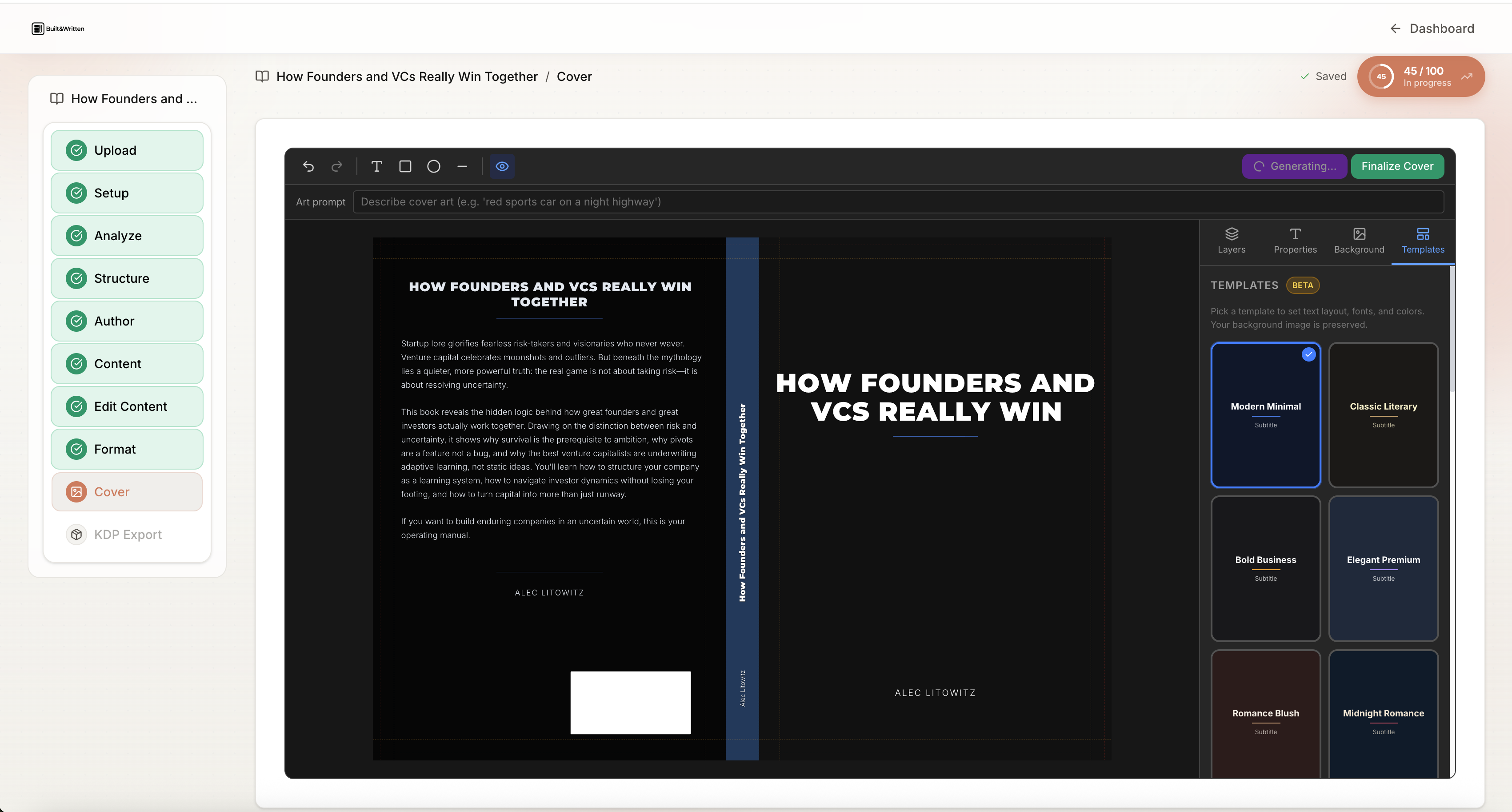
- Upload the paperback manuscript (print PDF from Built&Written or your tool of choice) and the cover PDF.
- Upload the Kindle version (ePub).
- Select your two KDP categories (research the lowest-ranked current bestseller in each).
- Set your backend keywords (7 fields, search-phrase format).
- Check the AI disclosure box if applicable.
- Set pricing (see the pricing strategy in the platform context section).
- Order one physical proof copy.
Week 4: Pre-launch
- Read the physical proof copy. Mark every typo, layout error, and image issue.
- Upload corrections.
- Send the book (Kindle or physical) to 20 to 30 readers who will write honest reviews.
- Record a two to three-minute LinkedIn video announcing the book, talking about one specific idea from it. This is your launch anchor content.
- Book at least two podcast appearances for the launch week (your own podcast, a peer's podcast, or a coaching community podcast).
- Email your existing list with a launch announcement and a direct buy link.
Week 5 to 6: Launch
- Post the LinkedIn launch video on day one of launch week.
- Have the 10-plus reviews live on Amazon before you announce publicly.
- Run the LinkedIn paid campaign if budget allows (targeting coaches or founders in your niche).
- Email your list again mid-week with a different angle (share one story from the book, not the whole pitch again).
- Monitor discovery calls booked daily. This is your primary metric, not Amazon sales rank.
Week 7 to 12: Sustain and optimize
- Send one email per month to book-funnel subscribers who did not book a discovery call (content email, not sales email).
- Review your Layer 2 resource conversion rate. Under 15% means the resource needs redesign.
- Review your Email 5 click-through rate. Under 10% means the email needs revision.
- Do one podcast appearance per month referencing the book.
- Add the book to your LinkedIn profile, email signature, and website bio.
- Consider one KDP free promotion day in month two to drive a new traffic batch.
The verdict: how to think about ROI on a coaching book
A coaching book is not a passive asset. Left alone, it does nothing. Wired correctly, it is the highest-ROI marketing asset most coaches will ever build. The key word is "wired."
The Coaching Book Lead-Gen Funnel makes the ROI math concrete. Every coach considering a book should run this calculation before starting:
- What is your average client engagement value? (Monthly rate x typical engagement length)
- What is your estimated close rate on a discovery call with a pre-qualified prospect?
- How many discovery calls per month can you absorb?
- How many email subscribers do you need to generate that many calls (at your estimated conversion rate)?
- How many book readers do you need to generate that many subscribers (at an assumed 20% Layer 2 conversion rate)?
- Is that number of book readers achievable in year one given your existing audience?
If the answer to question 6 is yes, the book is worth the project. If the answer is no, focus on audience-building first (LinkedIn content, podcast appearances, community involvement), then revisit the book when the Layer 1 traffic potential is large enough to justify the funnel.
Most coaches who run this calculation discover that 500 to 1,000 annual readers is enough to produce two to four clients per year, at a value of $20,000 to $80,000 depending on practice type. That is a book-as-marketing-investment that pencils out almost universally.
Where Built&Written fits in this model
Built&Written is the AI book platform we built specifically for coaches, consultants, and founders publishing for credibility. The platform handles content ingest via paste or upload, Voice DNA to preserve your voice across the manuscript, KDP-ready export, and the KDP Launch Co-pilot which generates an Amazon listing and a pre-filled launch post for LinkedIn. The lead-gen funnel layers (landing page, email sequence, Calendly) live in your existing tools.
The production cost at $15/month is the smallest line item in the ROI calculation. The funnel assets (landing page, email sequence, Calendly setup) take longer to build than the book in many cases, but Built&Written compresses the manuscript production time enough that coaches can shift the time saved into funnel-building.
For coaches who have been sitting on "I should write a book" for more than a year: the production barrier is now low enough that the only meaningful question is whether you will build the funnel. If yes, start the book. If no, don't bother. A book without a funnel is a credibility prop, not a business asset.
The coaches building books right now with a functional lead-gen funnel are the ones who will own their niche's authority positioning for the next three to five years. Hal Elrod self-published The Miracle Morning and built a community of millions of readers from a single book. James Altucher wrote Choose Yourself when most publishers had rejected the premise and built a multi-platform media business off the back of it. [verify] Neither of those outcomes required a traditional publisher. Both required a clear understanding of who the reader was and what they should do after they finished the last page.
The International Coaching Federation, the Forbes Coaches Council, and the practitioners at the highest end of the coaching market all point to the same pattern: authority-building compound. A coach with a book gets more podcast invitations. More podcast invitations get more book readers. More book readers produce more discovery calls. More discovery calls produce more clients who refer other clients. The compounding starts with the book. The book starts with the decision to wire it correctly.
The one-number summary
If you close two clients per year from your book funnel, and your average client engagement is worth $15,000, your book generates $30,000. At a production cost of $2,000 to $5,000 and a monthly platform cost of $15, your first-year ROI is 500% to 1,400%. That is not a credibility outcome. That is a business outcome. Run your own numbers. The math is not complicated. The only question is whether you build the funnel.
Key takeaways
- A coaching book is not a publishing project. It is the first layer of a five-layer lead-generation funnel.
- The Coaching Book Lead-Gen Funnel: book (Layer 1), free resource capture (Layer 2), email nurture (Layer 3), discovery call (Layer 4), retained client (Layer 5).
- Most coaches invest in Layer 1 and nothing in Layers 2 through 5. That is why most coaching books do not generate clients.
- The free resource at Layer 2 is the highest-leverage design decision in the entire funnel. A resource that requires the reader to do something (assessment, quiz, calculator) converts at two to three times the rate of a passive PDF download.
- The ROI math is straightforward: two clients per year from the funnel, at $15,000 average engagement value, equals $30,000 on a $2,000 to $5,000 production investment.
- Amazon KDP's 2026 AI disclosure policy requires disclosure, not prohibition. A coaching book built from the coach's own content is AI-assisted. Check the box and publish.
- The KDP author page, the backend keywords, and the category selection are free discoverability levers that most coaches never use.
- Build the funnel before the book launches. The QR code destination, the email sequence, and the Calendly page all need to be live and tested on launch day.
- Built&Written compresses the manuscript-production timeline enough that coaches can shift the saved time into building the funnel behind the book (landing page, email sequence, Calendly link).
- The coaches building books with wired funnels right now are building authority assets that will compound for three to five years. The window to own that positioning in your niche is open. It will not stay open indefinitely.
Frequently asked questions
How long does it take to generate a lead from a self-published coaching book?
The fastest path is a reader who finishes the book, scans the QR code in the back matter, and books a discovery call the same day. This happens routinely with engaged readers. The more typical timeline is 30 to 90 days from book launch to first client: launch week drives initial sales, readers take two to four weeks to finish the book, the five-email nurture sequence runs over five weeks, and discovery calls happen in weeks six through ten. Coaches who have an existing audience (email list or LinkedIn following) see this timeline compressed. Coaches starting with no audience see it extended.
What is a realistic conversion rate from book reader to coaching client?
Conservative benchmarks based on the composite patterns above: 25% to 40% of readers who finish the book reach the back matter and see the QR code. Of those, 15% to 30% convert to email subscribers. Of subscribers, 15% to 25% book a discovery call over the nurture sequence. Of discovery calls, 20% to 50% convert to retained clients depending on practice type and client fit. Applying these ranges to 500 book readers: 52 to 300 back-matter readers, 8 to 90 email subscribers, 1 to 23 discovery calls, 0 to 11 clients. The wide range reflects the single largest variable: how well the Layer 2 resource is designed. A quiz that produces a personalized score outperforms a generic PDF every time.
Can I give my book away for free and still use it for lead-gen?
Yes, and in many cases a free book generates more funnel activity than a paid book. A $0.99 Kindle on KDP Select during a free promotion day can produce thousands of downloads in 24 hours. Each download is a potential Layer 2 conversion. The royalty loss (the $0.35 you would have earned at $0.99, or the $0.00 you earn from a free day) is irrelevant if the client value from the funnel exceeds it by 10x to 100x. Many coaches run one paid Kindle edition ($4.99 to $9.99) for credibility and one free PDF edition on their website for list building, with separate but parallel email sequences for each.
Does Amazon allow a QR code linking to a discovery call in the back matter?
Yes. Amazon's content guidelines allow QR codes in the back matter of a book, including QR codes that link to external websites, email capture pages, and booking calendars. Amazon's restriction is on affiliate links and on content that is purely promotional without substantive editorial value. A coaching book with legitimate content that includes a back-matter QR code to a discovery call page is fully within the guidelines. Always check the current Amazon KDP content guidelines before launch, as policies can be updated.
What email platform should I use for the book funnel sequence?
ConvertKit is the most commonly used tool among coaches for book-driven email sequences. The free plan allows up to 1,000 subscribers and includes basic automation (tag-triggered sequences, which is exactly what the book funnel requires). Alternatives: Mailchimp (broader feature set, less coach-specific), Kit (ConvertKit's rebranded version with the same functionality), ActiveCampaign (more powerful but more complex for coaches who just need a five-email sequence). The tool matters less than the sequence. A five-email sequence that sounds like the coach, delivers genuine value, and includes a clear call to action in Email 5 will out-convert a sophisticated automation in a generic voice.
Will KDP's AI policies change and affect my book's discoverability?
Amazon's AI content policy has evolved since its introduction and may continue to evolve. The current policy (early 2026) requires disclosure but does not penalize or restrict AI-assisted books. The risk area Amazon has consistently flagged is high-volume, low-quality AI-generated content flooding the store. A single coaching book, built from the coach's own content, with a named author and a functioning author page, is not what Amazon's policy is targeting. The practical risk for a coaching book using AI assistance is low. That said, bookmark the KDP AI content policy page and review it before each book launch.
How many books do I need to maximize lead-gen from the Amazon ecosystem?
One flagship book is enough to start the funnel. A second shorter book (a workbook, a companion guide, a lead-magnet booklet at $0.99 or free) can serve as a second top-of-funnel entry point that routes into the same email sequence. Amazon's algorithm surfaces related books from the same author to readers browsing the category, so two books create more total surface area than one. The practical starting point: one flagship book, one funnel. A second book in year two extends the funnel's top without requiring you to rebuild everything behind it.
What does "Voice DNA" mean for a coaching book and why does it matter for leads?
Voice DNA is Built&Written's named feature for voice fingerprinting: the tool ingests the coach's existing writing (LinkedIn posts, podcast transcripts, client-facing materials) and builds a profile of their writing patterns (sentence length, vocabulary, rhetorical structure, characteristic phrases). The AI then uses this profile to generate and bridge content that matches the coach's voice rather than producing generic AI output. For lead-gen specifically, voice matters because the email nurture sequence after the book must sound like the book. A reader who subscribed because of the book's direct, data-driven voice will unsubscribe from emails that sound like a different person. Voice consistency from book to email to discovery call is a non-trivial factor in conversion rate at Layers 3 and 4.
Sources and references
- Amazon KDP Content Guidelines
- Amazon KDP AI Content Policy
- KDP Select Enrollment Information
- Amazon Author Central
- International Coaching Federation Industry Research
- Forbes Coaches Council
- ConvertKit
- Calendly
- Built&Written
- StoryBrand by Donald Miller
- The Prosperous Coach by Rich Litvin
- The Miracle Morning by Hal Elrod
Related guides
Sources & References
- https://kdp.amazon.com/help/topic/G201834180
- https://kdp.amazon.com/en_US/help/topic/G200672390
- https://kdp.amazon.com/help/topic/G200645570
- https://author.amazon.com
- https://coachingfederation.org/research
- https://www.forbes.com/sites/forbescoachescouncil/
- https://convertkit.com
- https://calendly.com
- https://www.builtwritten.com/
- https://storybrand.com
About the author

Michael Pavlovskyi
Connect on LinkedInReady to write your book?
Turn your expertise into a professional book with Built&Written.
Put your book on the page