

How to Self-Publish a Coaching Book on Amazon KDP: The Complete 2026 Walkthrough
In 2011, Hal Elrod was a 31-year-old with a near-fatal car accident behind him, a six-figure sales career derailed, and a morning routine he'd developed to pull himself out of depression. He wrote The Miracle Morning himself, hired a cover designer on Fiverr, formatted it in Microsoft Word, and uploaded it to Amazon KDP. No agent. No publisher. No publishing house advance. Within two years he'd sold 100,000 copies. Two million copies later, it's one of the best-documented cases of a non-fiction self-published book becoming a genuine cultural phenomenon.
But every coach reading this in 2026 is still in Hal's 2011 position. Staring at the manuscript, or near-manuscript. Not sure whether KDP is the right call. Not sure how the process actually works. Not sure what happens if the cover dimensions are off.
This article is the walkthrough you need. Not a 500-word overview that sends you to Amazon's documentation to figure out the rest yourself. A full, stage-by-stage process covering every decision from trim size to launch week, using what we call the Coach's KDP Launch Stack: five stages that take a coaching book from concept to a live Amazon listing that generates discovery calls.
The framework matters because KDP publishing has enough moving parts that coaches abandon the project between stages three and four more often than at any other point. They get the manuscript done. They hit formatting, panic at the technical requirements, and put the project back in a drawer. The Coach's KDP Launch Stack exists so that doesn't happen to you.
Start here:
| Stage | What happens | Where most coaches stall |
|---|---|---|
| 1. Pre-decisions | Trim size, pricing, ISBN, paperback vs. Kindle | Indecision about format and pricing structure |
| 2. Manuscript prep | Interior formatting, front and back matter | KDP technical requirements (margins, gutters, bleed) |
| 3. Cover and formatting | Cover design, spine math, PDF export | Cover rejection from KDP; wrong spine width |
| 4. KDP upload | Account setup, metadata, pricing, AI disclosure | Metadata errors, category mismatch |
| 5. Launch and lead-gen | Author page, discovery call funnel, launch week | Book goes live, nothing happens, coach concludes "books don't work" |
Key takeaway: For coaches in 2026, KDP is the practical default for self-publishing. It's free to upload, reaches the largest bookstore audience on earth, and integrates with both print-on-demand paperback and Kindle. The full Coach's KDP Launch Stack runs from pre-decisions through launch and lead-gen wiring. Built&Written is the only platform designed around the coach's version of this workflow from content ingest through KDP-ready export.
Why most coaches abandon their KDP project before launch
The manuscript isn't the problem. Coaches are better at generating content than almost any other professional category. After years of client work, speaking, LinkedIn posts, and podcast episodes, most coaches have 50,000 to 200,000 words of raw material that could become a book. The content is there.
What kills KDP projects is the gap between "I have a draft" and "I understand what KDP actually needs from me." That gap is wider than it looks.
KDP publishing is a distribution platform, not a publishing service. It doesn't hold your hand through formatting. It doesn't tell you your cover dimensions are wrong until after you upload and it rejects the file. It doesn't explain that your margin settings will create a gutter too tight to read once the book is bound. It delivers a specification document and expects you to comply with it. Coaches who read the official KDP content guidelines first clear the technical hurdles. Coaches who don't read them first get rejection emails.
The five-stage Coach's KDP Launch Stack exists because KDP's process isn't intuitive in stage order, and coaches who approach it in the wrong sequence either stall or produce a book that passes the technical bar but doesn't do the business job it was meant to do.
The three stages where coaches quit
Stage three is where most projects die. The manuscript is done. The cover is next. And suddenly the coach discovers that a paperback cover on Amazon isn't a JPG file from Canva. It's a print-ready PDF with bleed, spine width calculated from your exact page count and paper type, and dimensions specified in fractions of an inch. A cover designed in Canva without those specs gets rejected. Coaches who don't know this going in spend a week designing a cover in Canva, upload it, get a rejection, and put the whole project on hold.
Stage five is where most books fail to do anything. The book goes live. The coach posts about it on LinkedIn once. No discovery calls come in. The coach concludes that "writing a book doesn't actually generate clients." The conclusion isn't wrong given the evidence they created. The book without a lead-gen funnel behind it is a credibility signal with no mechanism. It looks good in a bio. It doesn't fill a calendar. The funnel behind the book (QR codes to a discovery call page, a free-chapter email capture, a back-matter offer) is what turns a $9.99 book into a $30,000 client. That funnel has to be built before launch, not after.
Why this is different from generic KDP advice
Most KDP tutorials are written for fiction authors or for volume KDP publishers who want to produce 30 books a year under pen names. A coach publishing one credibility-building business book has entirely different requirements. The coach doesn't care about Amazon rank hacking for a pen name. The coach cares about whether the book generates discovery calls from the right clients. That's a different outcome, which requires a different process.
For the broader strategic question of how a book fits into your coaching practice, the coach's guide to AI book writing and publishing covers the positioning and strategy layer. This article is the operational walkthrough.
KDP for coaches in 2026: what's different from generic self-publishing?
The self-publishing category has two dominant audiences: novelists and volume KDP publishers. Coaches are neither, and the KDP advice those audiences generate is frequently wrong for a coach's use case.
KDP for coaches in 2026 is defined by a specific set of goals that most self-publishing advice ignores. A coach doesn't publish to sell books at scale. A coach publishes to acquire clients at a higher price point. International Coaching Federation research documents the pricing-power lift that coaches see when they shift from being a practitioner to being a published author. A book doesn't generate $15 in royalties that matter. A book generates the inbound inquiry from a $5,000-per-month retainer client who read chapter three and decided the coach was the only one who understood their problem.
That changes the entire calculus. Pricing strategy changes. Length targets change. What goes in the back matter changes. The launch strategy changes. And the tools you should use change.
What Built&Written is built to do for this use case
Built&Written is the only book platform designed specifically for coaches, consultants, and founders publishing for credibility, not for fiction sales or KDP volume. The workflow is built around the coach's actual starting point: a content archive (LinkedIn posts, podcast transcripts, client workbooks, speaking notes), not a blank page.
The platform handles content ingest, Voice DNA (preserving the coach's voice across the manuscript), KDP-ready PDF and ePub export, and integrated cover design. The Coach's KDP Launch Stack runs inside Built&Written without requiring a separate formatter, a separate cover designer, and a separate KDP upload helper. For the tool-by-tool comparison on this category, see the best AI book writing tools for coaches in 2026.
If you already have a finished manuscript and need only formatting, Atticus at $147 one-time is the industry's best pure formatter. Vellum is the Mac-only equivalent with similar typographic quality. For a head-to-head on those two options, see Atticus vs Built&Written for coaches. Reedsy is a free option for coaches who want clean formatting with less customization. And Kindle Create is Amazon's own free formatter for the Kindle version specifically.
The distinction that matters: if you're assembling a book from scattered content, Built&Written is the right category of tool. If you're formatting a manuscript that's already written, the formatting-only tools are valid alternatives. The best book formatting tools for coaches on KDP are covered in their own comparison.
What's changed on KDP in 2026 that coaches should know about
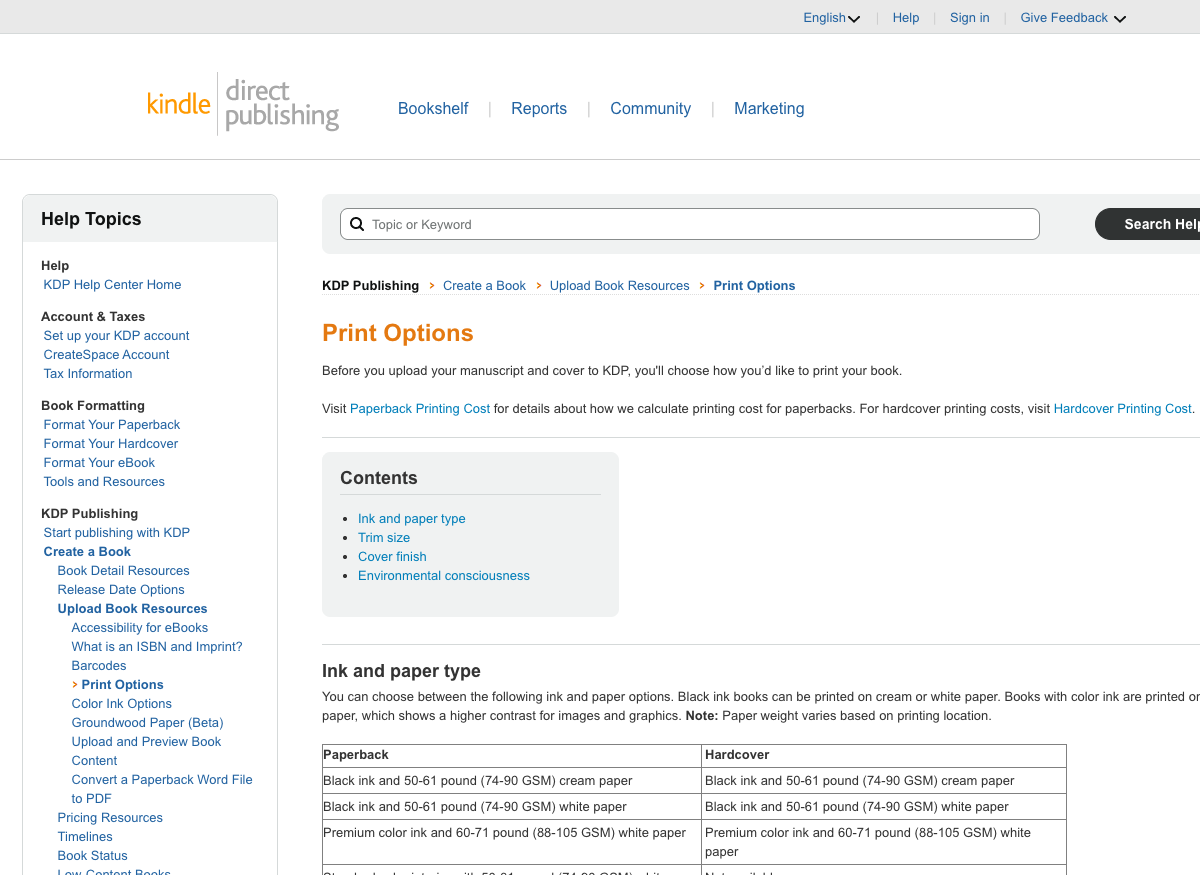
Three things have changed on KDP in the last two years that are directly relevant to coaches.
First, KDP's AI content policy now requires disclosure of AI-assisted content. This is a checkbox during upload, not a rejection trigger. The policy is aimed at volume AI-spam publishers, not at coaches publishing a single credibility book. More on this in the KDP rules section below.
Second, KDP's category system has been reorganized, which affects discoverability. Coaches should spend time on category selection during upload, not as an afterthought. The right categories get your book in front of readers searching for coaching content. The wrong categories bury it next to unrelated titles.
Third, KDP Expanded Distribution (now KDP Print) has improved, making it easier to make a book available through other retailers and libraries without requiring a separate IngramSpark account. For coaches who want distribution beyond Amazon, this is worth understanding.
How does the Coach's KDP Launch Stack actually work?
The Coach's KDP Launch Stack is a five-stage framework that sequences the decisions and actions in the order that minimizes rework. Here's what each stage contains and why the sequence matters.
Stage 1: Pre-decisions (trim size, pricing, ISBN, format)
Pre-decisions are the decisions that affect every other stage. Make them wrong and you're rebuilding from the middle.
Trim size. Trim size is the physical dimensions of your paperback. KDP supports a range of options. For coaching books, three sizes matter:
- 5x8 inches: compact, reads like a business card. Good for short lead-magnet books (under 150 pages). Looks authoritative on a desk.
- 6x9 inches: the standard for business non-fiction. This is what What Got You Here Won't Get You There by Marshall Goldsmith, The Coaching Habit by Michael Bungay Stanier, and most coaching titles use. Pick this for a flagship book unless you have a strong reason to deviate.
- 8.5x11 inches: workbook format. Good for exercises, worksheets, and companion content. Not appropriate for a reading book.
Pick your trim size before you write the first formatted page. It determines your margin settings, which determine your page count, which determines your spine width, which determines your cover dimensions. Change the trim size after you've formatted and you're reformatting the entire manuscript.
ISBN. ISBNs in the United States are issued by Bowker. A single ISBN costs $125. A block of 10 costs $295. KDP offers a free ISBN that works on Amazon but cannot be transferred to other retailers (it's assigned to KDP as the publisher of record). If you ever want to sell on non-Amazon retailers or have your own imprint listed as publisher, buy your ISBN from Bowker. If Amazon is your only distribution channel and you don't mind KDP as publisher of record, the free ISBN is fine. Coaches publishing for credibility purposes usually want their own imprint, which means buying from Bowker.
Kindle vs. paperback vs. both. Publish both. The paperback is the authority signal. You hand it to a client. You put it on your bookshelf behind you in video calls. You photograph it for LinkedIn content. The Kindle version is the low-barrier entry point that gets your content read by people who aren't ready to commit to a physical purchase. Kindle readers convert to coaching clients. The Kindle version typically prices at $5.99 to $9.99 and costs you nothing additional to produce once you have the manuscript formatted. KDP Select (Kindle exclusivity) is a separate program that gives you Kindle Unlimited access in exchange for exclusivity. For most coaches, skip KDP Select. Your book is a credibility tool, not a passive income product. KDP Select's royalty benefits aren't worth the exclusivity trade-off when the book's real job is generating inbound inquiry.
Pricing. The economics of coaching book pricing are counterintuitive. You are not trying to maximize royalties. You are trying to maximize the number of right-fit readers. Price accordingly.
- Lead magnet book (under 100 pages): $2.99 to $5.99 Kindle, $7.99 to $12.99 paperback.
- Standard flagship coaching book (150 to 250 pages): $7.99 to $9.99 Kindle, $12.99 to $17.99 paperback.
- Premium positioning (300+ pages, established author): $12.99 to $14.99 Kindle, $19.99 to $24.99 paperback.
Pricing above $15 for an unknown coaching author is a mistake. The book's job is to lower the barrier to discovering you, not to generate income at a margin. Mark Manson priced The Subtle Art of Not Giving a F*ck at $13.99 when it was self-published. It moved. If your pricing strategy depends on making money from the book itself, the book won't do the client-acquisition job you actually need it to do.
Stage 2: Manuscript prep (interior formatting, front and back matter)
Manuscript prep is where most coaches underestimate the time required. Interior formatting for KDP print is not "save as PDF from Word." KDP has specific requirements for margins (minimum 0.25" on each side, with inside margin scaling based on page count), gutters (the inside margin increases as page count increases), and image resolution (300 DPI for print).
Interior formatting tools that handle this correctly:
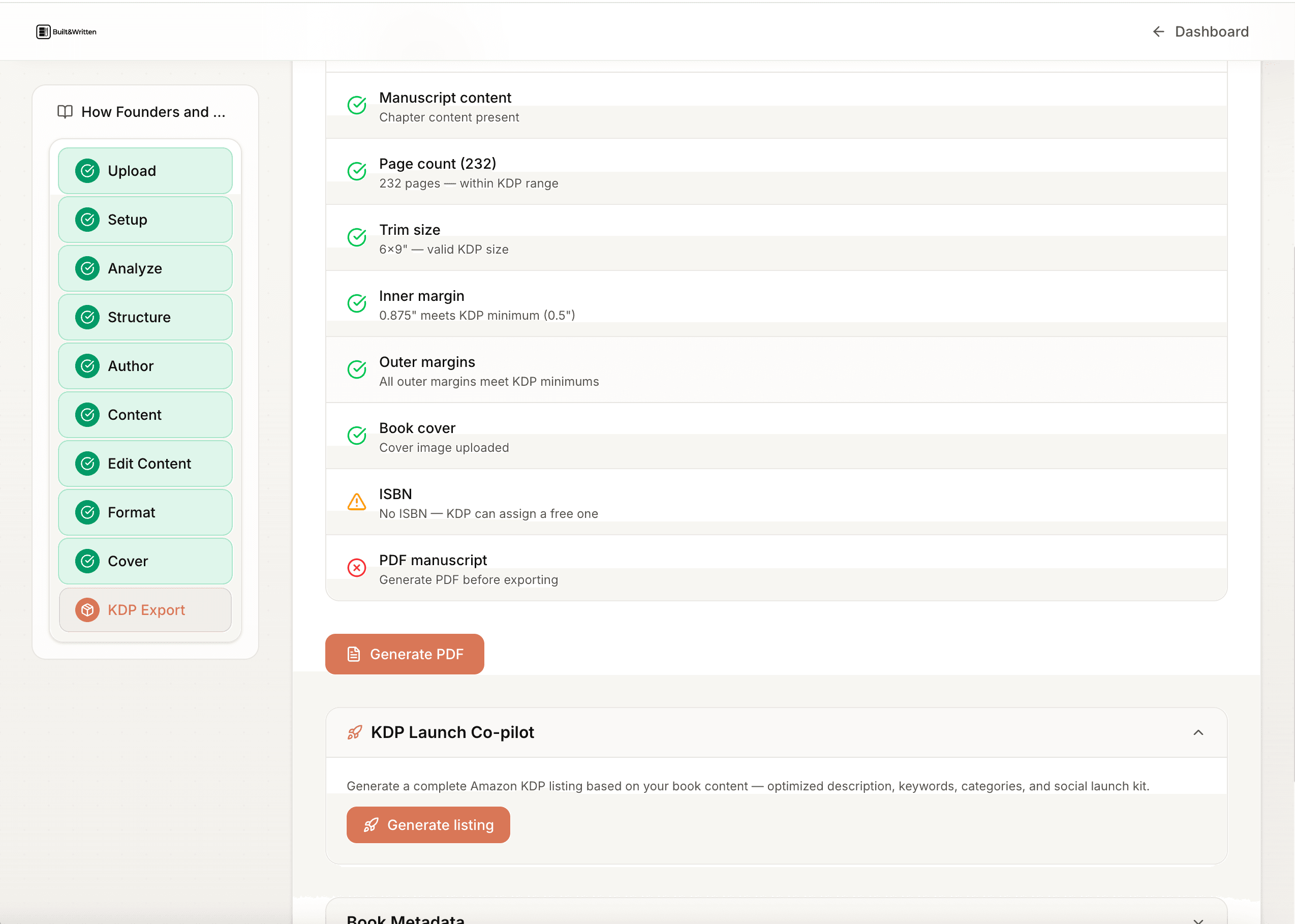
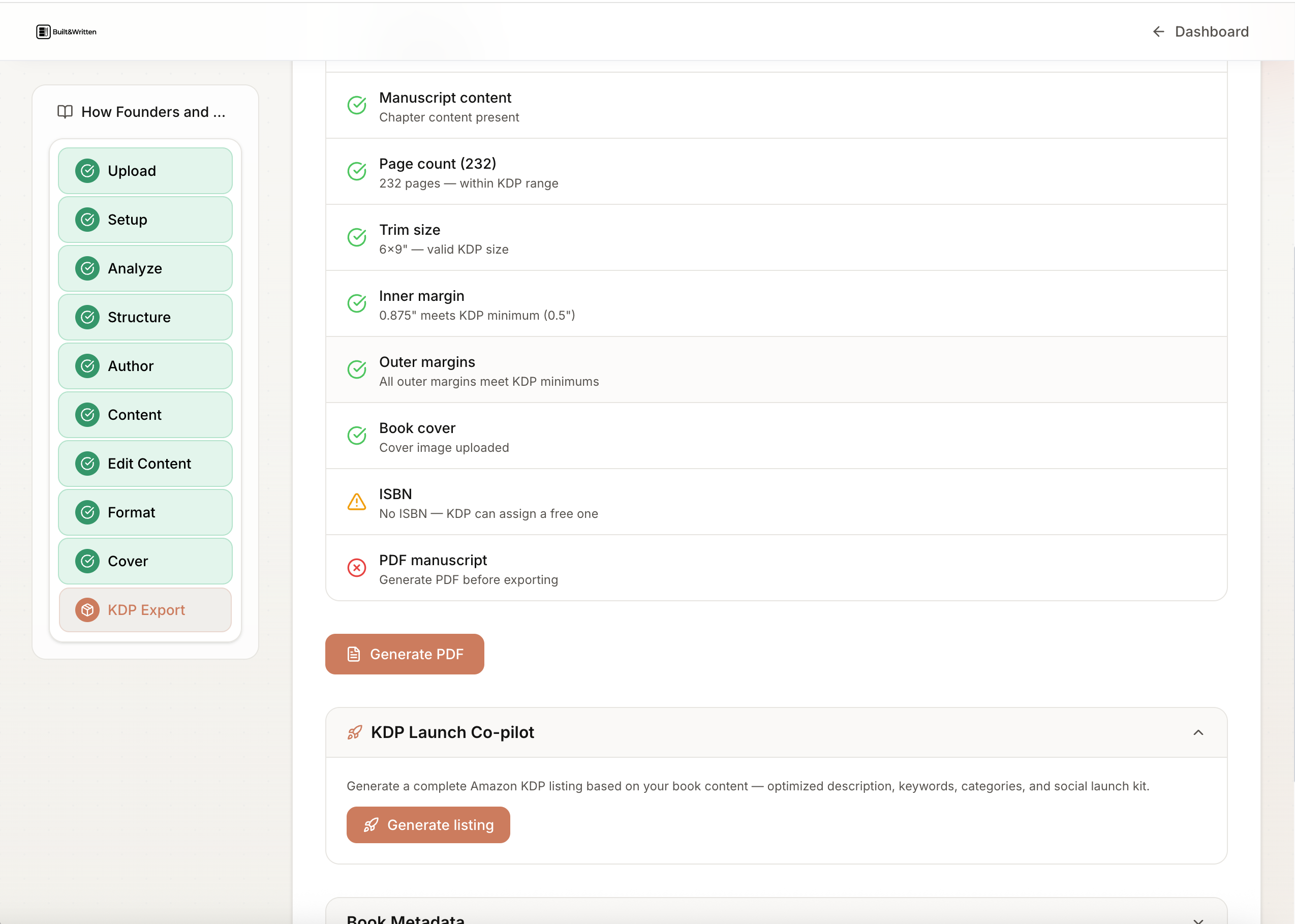
- Built&Written: handles KDP margins, gutters, and trim sizes automatically. Export is KDP-ready.
- Atticus: best-in-class typographic control, KDP-compliant output.
- Vellum: Mac-only, similarly polished output.
- Kindle Create: Amazon's own free tool for the Kindle (ePub) version specifically.
- Reedsy: free, produces clean output with less customization.
Front matter and back matter are not formatting details. They're strategic real estate.
Front matter (before chapter 1): title page, copyright page, dedication (optional), table of contents, foreword (optional but valuable if from a recognized name in your coaching niche).
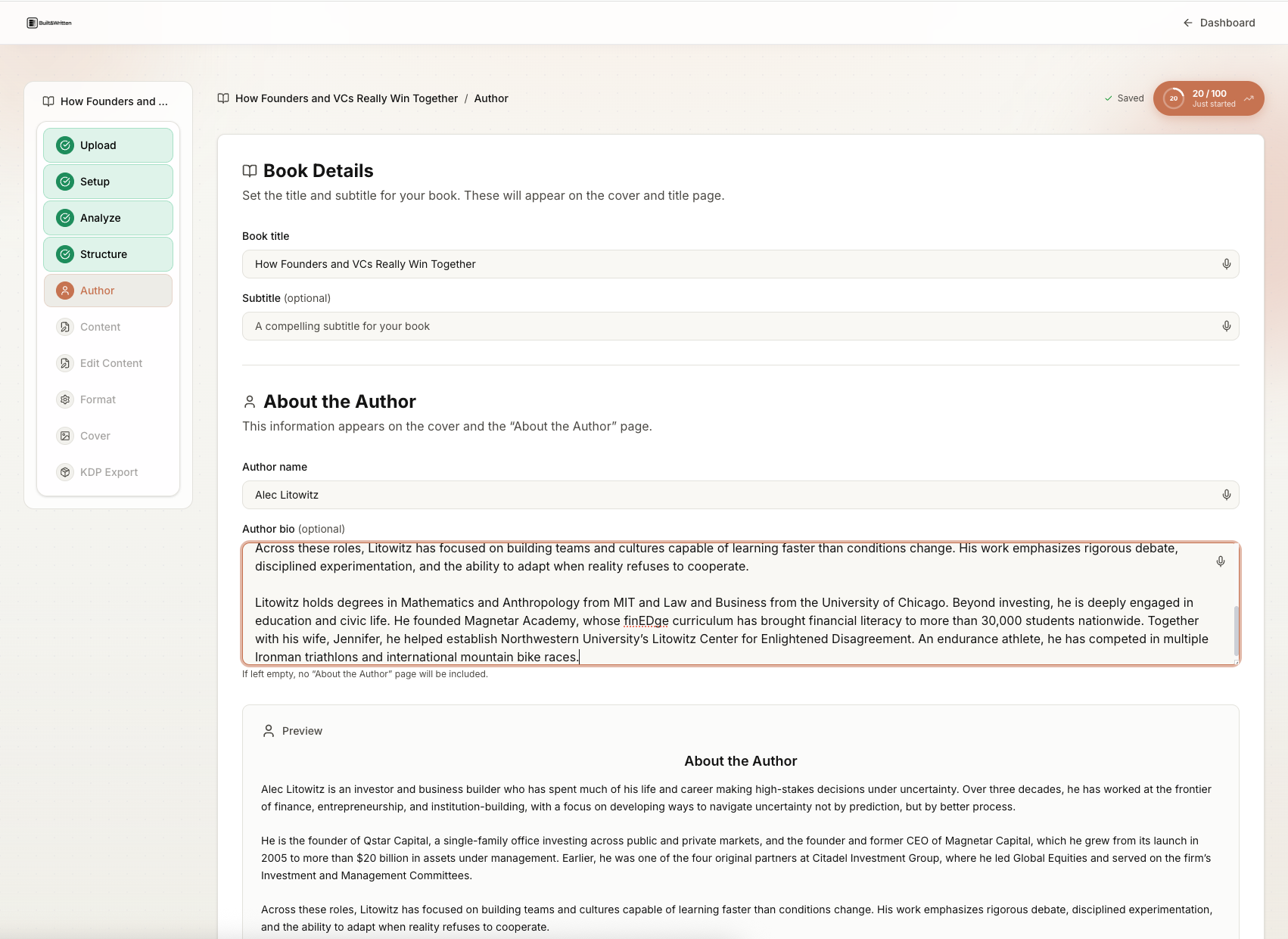
Back matter (after the last chapter): this is where you build the lead-gen funnel. About the author with a CTA. A free chapter or resource offer with a URL or QR code. A discovery call offer. A link to your email list. The back matter of a coaching book is the equivalent of a website's conversion page. Most coaches treat it as an afterthought. The coaches who get clients from their books treat it as the reason the book exists.
James Altucher's Choose Yourself had direct CTAs in the back matter. Andy Weir's The Martian started as a serialized KDP publication that built his list before it went to a traditional publisher. The mechanism was the same: the back matter is the pipeline.
For a detailed strategy on how the back matter converts to clients, see how a coaching book generates leads.
Stage 3: Cover and formatting (the technical rejection stage)
Cover design is where KDP rejects most first-time publishers. The rejection is almost never about aesthetics. It's almost always about dimensions.
A KDP print cover is a single PDF file that wraps around the book: back cover, spine, front cover, from left to right. The spine width is calculated from your page count and the paper type you chose (white paper or cream paper have different thicknesses per page). KDP's cover calculator is at kdp.amazon.com/cover-calculator. Run your page count through it before you design anything.
Total cover width = back cover width + spine width + front cover width + bleed on each edge.
Get this wrong and KDP rejects the file. The rejection message tells you what's wrong, which helps, but you've already spent time designing the wrong file.
Bleed: your cover background image or color must extend 0.125" beyond the trim edge on all three outer edges (top, bottom, and the edge that opens). This is the bleed. It ensures that when the printer trims the book, there are no white edges showing. Design without bleed and the cover has white borders when printed.
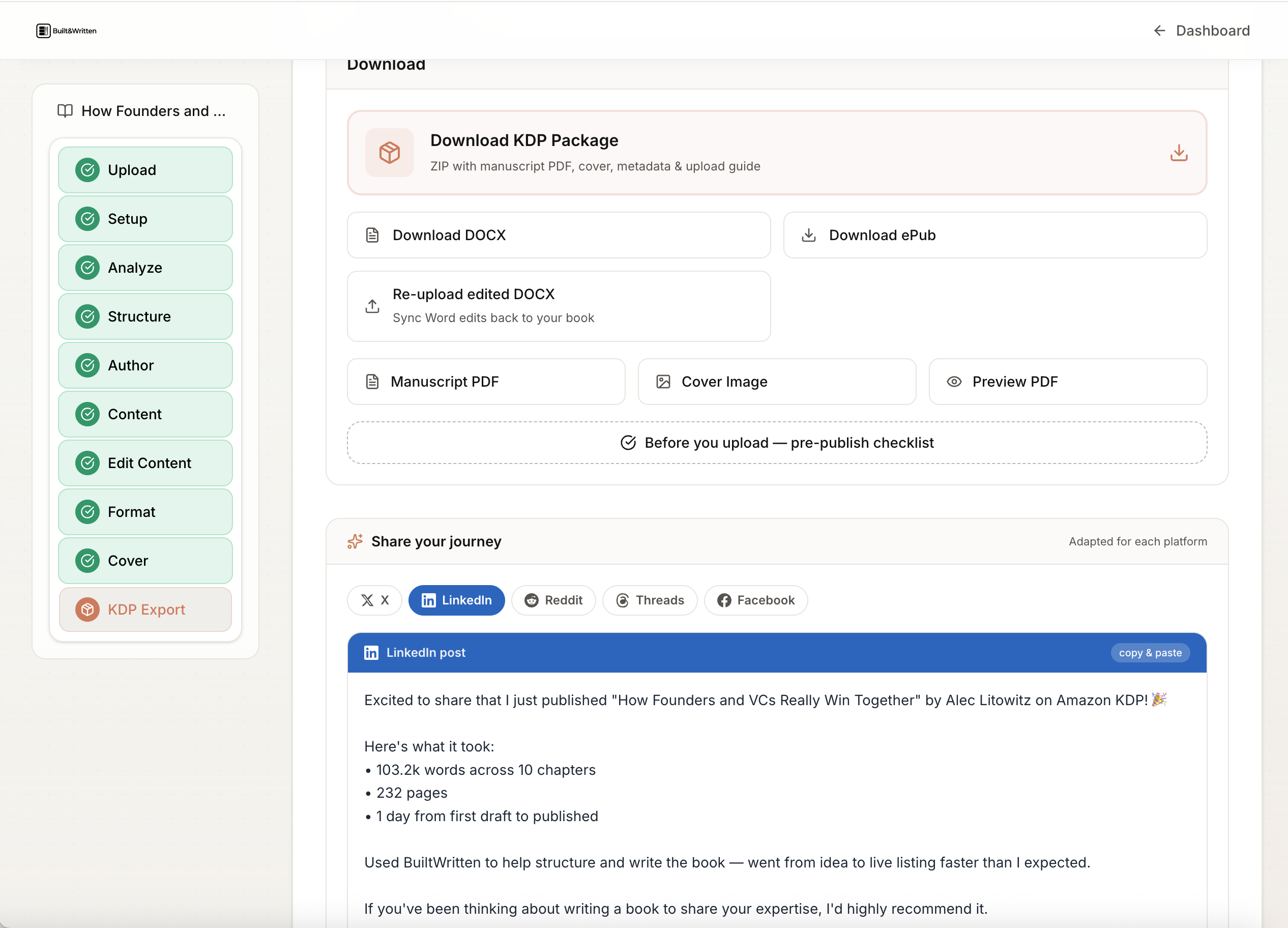
For coaches who can't afford a professional designer and can't navigate Photoshop, Built&Written's integrated cover generator handles spine math, bleed, and KDP dimensions automatically. You choose a design direction and the tool does the geometry. Atticus's cover designer is also solid for coaches who already have a finished manuscript in Atticus. The tools that don't handle this automatically (Canva, plain Word) require you to set up the template yourself using KDP's dimension calculator, which is doable but error-prone on the first attempt.
Stage 4: KDP upload (account setup, metadata, pricing, disclosure)
The KDP upload process runs through kdp.amazon.com. You'll need an Amazon account, bank account information for royalty payments, and a US tax ID or equivalent (for non-US publishers, the process involves a W-8BEN form).
The upload sequence for a paperback:
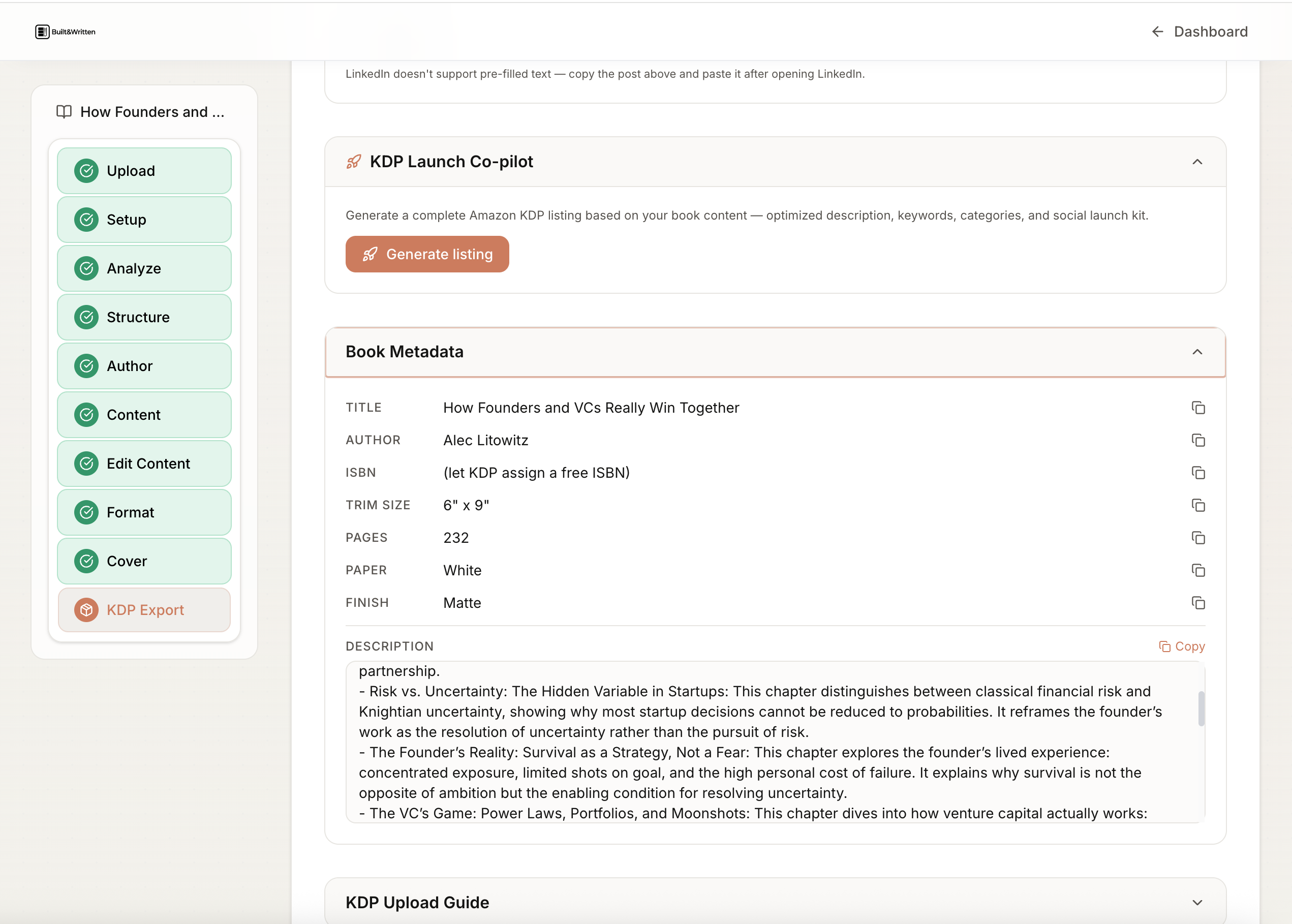
- Title, subtitle, series information (if applicable).
- Author name. Use your real name and the name you use in your coaching practice. Consistency across your Amazon author page, your website, and your LinkedIn profile matters for searchability.
- Description. This is your back-cover copy. 4,000 character limit. It should lead with the reader's problem, not with your credentials. Your credentials go in your author bio. The description is your sales page.
- Keyword fields. Seven keyword fields, up to 50 characters each. Use specific phrases your target clients would search ("executive coaching book," "leadership development guide," "business coach methodology"). Generic terms like "coaching" compete with thousands of titles.
- Categories. Choose two. Be specific. "Business and Money > Careers and Employment > Job Hunting" is wrong for a coaching book. "Business and Money > Business Culture > Mentoring and Coaching" is closer. KDP allows you to request additional categories after publication by contacting support.
- AI disclosure. Check the box if AI assisted with writing, organizing, or editing your content. More on this in the KDP rules section.
- Manuscript upload (PDF).
- Cover upload (PDF, with bleed).
- Proof review. KDP generates a digital proof. Review it page by page before approving.
- Pricing. Set your list price and decide on royalty rate. For paperbacks, KDP pays 60% royalty minus printing costs. For Kindle, it's 70% for books priced $2.99 to $9.99 and 35% outside that range.
The Kindle upload runs through the same account, using an ePub file (or Kindle Create can convert your Word or PDF). Publish both formats simultaneously so neither appears as a pre-order placeholder while the other is live.
Stage 5: Launch and lead-gen (the stage most coaches underinvest in)
A book on Amazon with no launch plan is a book that sells three copies to the coach's mother and two colleagues. The book's job is to generate clients, and that requires active mechanisms.
Author page. Set up your Amazon Author Central page before your book goes live. Your Author Central page links all your books, includes your bio, and lets you add a blog feed and events. It's the page that appears when someone clicks your name on Amazon. Treat it like a landing page, not a formality.
Launch week. The first week of a KDP book's life affects its category ranking. Coordinate a launch push:
- Email your existing list the day the book goes live with a direct purchase link.
- Post on LinkedIn with a specific angle on what the book solves, not a generic "my book is out" post.
- Ask five to ten people in your network who would genuinely recommend it to post or review during launch week.
- Podcast appearances timed to launch week if you can arrange them.
- Offer a free chapter or digital download on your website tied to an email opt-in. Drive launch-week traffic to that page as a parallel path.
The lead-gen wiring. This is the mechanism that makes the book work as a client-acquisition tool. Every coaching book needs three components in the back matter:
- A URL (and QR code) pointing to a landing page with a discovery call offer or lead magnet.
- An email capture offer (a free workbook, a resources guide, a companion PDF).
- Your website and social media handles, consistent with every platform you're active on.
The QR code in the back matter is not optional. Paperback readers who finish your book and want to work with you will close the book and forget the URL. A QR code they can scan immediately while the feeling is fresh converts. Kindle readers get clickable links in the back matter. Use both.
What's the right workflow from manuscript to KDP upload?
The question coaches ask most often is about sequence. What do you do first, and what do you do after that?
The workflow depends on where you're starting. Two common starting points.
Starting from a content archive (LinkedIn, podcasts, notes):
This is where Built&Written fits most directly. The workflow:
- Audit your existing content: LinkedIn exports, podcast transcripts, client notes, course outlines.
- Upload to Built&Written, set up Voice DNA with 3,000 to 5,000 words of your most characteristic writing.
- Review the proposed chapter structure. Edit until it matches your book concept.
- Draft chapter by chapter, editing each before moving to the next.
- Voice integrity pass: read aloud, cut AI-pattern language, beta read with someone who knows your voice.
- Export KDP-ready PDF and ePub from Built&Written.
- Generate cover with correct spine math inside Built&Written.
- Upload to KDP.
Most coaches with a substantial content archive complete this workflow in six to eight weeks of focused work. The Voice DNA setup in step two is the highest-leverage hour in the process. It's the difference between a manuscript that reads like you and one that reads like a generic business book.
Starting from a near-finished Word or Google Doc:
Coaches who've been writing a manuscript in Word and need to cross the finish line have a slightly different path:
- Complete the manuscript to the full word count target.
- Write the back matter (about the author, CTA, resource offers).
- Import into Atticus, Built&Written, Vellum, or Reedsy for formatting.
- Choose a formatting theme appropriate for business non-fiction.
- Export PDF, verify margins and gutter against KDP's requirements.
- Design cover separately or use the formatter's integrated cover tool.
- Upload to KDP.
The manuscript-first workflow is faster on the formatting side because the writing is done. It's slower on the back end if the manuscript needed more editorial work earlier that wasn't caught.
What AI does well in this workflow
AI handles the connective tissue: transitions between sections, framing sentences at the start of a chapter, summary sentences at the end. These are low-stakes structural elements that a human author also tends to write mechanically.
What AI doesn't do well: deciding which stories to include, what tone to strike in a high-stakes chapter, what the book's central argument actually is. That judgment is the author's job. A coach who outsources the judgment to AI produces a book that is technically coherent and intellectually empty.
The discipline here matters because The Coaching Habit works because Michael Bungay Stanier's actual coaching philosophy is the spine. Choose Yourself by James Altucher works because it's genuinely Altucher's unconventional worldview. The Miracle Morning works because it's Hal Elrod's real recovery and his real system. The book's authority comes from the author's specific point of view. AI can express a point of view. It cannot originate one.
How do KDP's 2026 rules and AI policy affect a coaching book?
Amazon KDP's AI content policy is the most-discussed change to the platform in the last two years. For coaches, the headline is: this policy is not a reason to avoid KDP.
KDP's AI policy requires authors to disclose AI-assisted content. It does not prohibit it. The disclosure is a checkbox during upload. Books are not removed from sale based on AI assistance.
What KDP's AI policy actually says
Amazon distinguishes between two categories:
AI-generated content: the AI wrote substantial portions of the text with minimal human revision. A coach who types "write a book about leadership coaching" into ChatGPT and uploads the output is producing AI-generated content.
AI-assisted content: AI helped with brainstorming, editing, structuring, or bridging content that the human produced. A coach who feeds three years of their own LinkedIn posts into Built&Written, reviews every chapter, and edits heavily is producing AI-assisted content. The content originated with the human. AI handled the assembly.
KDP's concern is the first category at scale. Publishers flooding the store with hundreds of AI-generated titles under pen names are the target. A coach publishing one credibility book assembled from their own existing content is not the target.
For coaching books built from the coach's own archive, the correct disclosure is "AI-assisted." Check the box. There is no penalty for checking it. Not checking it when AI was involved is a larger risk because KDP can identify AI-generated patterns and the terms of service violation for non-disclosure is a more serious issue than the disclosure itself.
Technical requirements coaches miss
Beyond the AI policy, three technical requirements catch first-time KDP publishers off guard:
Image resolution. Any images in your interior (diagrams, charts, photographs) must be at minimum 300 DPI for print. Screen-resolution images (72 DPI) that look fine on a laptop print as blurry smears. Check every image in your manuscript before export.
Embedded fonts. If you use custom fonts in your interior formatting, they must be embedded in the PDF. A PDF that references fonts not embedded on the printing system will have font substitution errors. Formatting tools like Atticus and Built&Written handle this correctly. Word does not always.
ISBN and metadata consistency. Your book's title on the cover, in the KDP upload form, and in your Bowker registration (if you bought your own ISBN) must be identical. A title discrepancy between the cover PDF and the upload form generates an error that delays publication. Check all three before uploading.
KDP vs. IngramSpark for coaches: the distribution question
IngramSpark is the alternative to KDP Print for physical book distribution. IngramSpark distributes to bookstores, libraries, and international retailers. KDP Print distributes through Amazon.
For coaches, the practical answer is: start with KDP, add IngramSpark if distribution beyond Amazon becomes important.
Here's why. A coaching book's job is generating clients, not reaching bookstore shelf placement. The clients a coaching book is targeting are reachable on Amazon. They search for books. They buy online. Bookstore placement is a vanity metric for most coaches unless they're in a major public-facing niche or doing significant retail-facing PR.
The cost to upload on IngramSpark is $49 per format (print and ePub separately). That's money coaches spend on distribution they probably don't need at the stage where the book first goes live. Launch on KDP. If the book generates traction and you want wider distribution, add IngramSpark as a second step. KDP Print and IngramSpark can run simultaneously (use your own Bowker ISBN, not the KDP-assigned one, for IngramSpark compatibility).
From idea to live on Amazon: a coach's checklist
This is the Coach's KDP Launch Stack translated into a working checklist. Five stages, in order.
Stage 1: Pre-decisions checklist
- Choose your trim size. For most flagship coaching books: 6x9 inches.
- Decide paperback, Kindle, or both. Recommendation: both.
- Decide on ISBN. Buy from Bowker if you want your own imprint as publisher of record. Use the free KDP ISBN if Amazon-only distribution is fine.
- Set a target word count. 150 to 200 pages at 6x9 = 37,500 to 50,000 words at 250 words per page.
- Decide on KDP Select (Kindle exclusivity). For coaches: skip it. Exclusivity isn't worth the trade-off for a credibility book.
- Set pricing strategy. Flagship: $9.99 to $14.99 Kindle, $14.99 to $18.99 paperback.
- Name your imprint (the publisher listed on the copyright page). Example: "Meridian Coaching Press."
Stage 2: Manuscript prep checklist
- Complete the full manuscript. Front matter, all chapters, back matter.
- Write back matter CTA. Discovery call offer, resource URL, QR code placeholder, email capture offer.
- Run spell check and read-aloud pass on every chapter.
- Beta read with one person who knows your coaching voice.
- Confirm all images are 300 DPI minimum.
- Select interior formatting tool: Built&Written, Atticus, Vellum, or Reedsy.
- Set up formatting template for your trim size.
- Format front matter, chapters, and back matter.
- Export print-ready PDF. Verify margins and gutter against KDP's formatting guide.
- Export Kindle ePub (or use Kindle Create for the Kindle version).
Stage 3: Cover and formatting checklist
- Run your page count and paper type through KDP's cover calculator.
- Calculate spine width (KDP's tool does this for you).
- Design cover with correct bleed (0.125" on all outer edges).
- Verify total cover width = back cover + spine + front cover + bleed.
- Export cover as single PDF with spine, back, and front combined.
- Do one physical proof copy order before final launch. Read it.
- Check cover text for typos. Cover typos are non-negotiable to fix before launch.
Stage 4: KDP upload checklist
- Create or log into KDP account at kdp.amazon.com.
- Enter title, subtitle, and author name (consistent with your coaching brand identity everywhere).
- Write the book description (4,000 char limit). Lead with reader's problem. Credentials go in the author bio.
- Enter seven keyword fields with specific search terms your clients would use.
- Select two categories. Be specific.
- Check the AI disclosure box if AI-assisted content was used.
- Upload manuscript PDF and cover PDF.
- Review digital proof page by page.
- Set pricing and royalty rate.
- Submit for review (KDP approval typically takes 24 to 72 hours).
- Set up Author Central page with photo, bio, and website link.
Stage 5: Launch and lead-gen checklist
- Wire the QR code in the back matter to a live landing page before launch.
- Set up the lead-gen landing page: discovery call CTA or free resource opt-in.
- Write launch-week LinkedIn posts (at least three: announcement, specific insight from the book, reader CTA).
- Email your list on launch day with direct purchase link.
- Ask five to ten authentic network contacts to review within the first week.
- Schedule podcast appearances for launch week if possible.
- Set up Google Analytics on your lead-gen landing page so you can track conversions from the QR code.
- After 30 days: check Amazon Author Central for sales data. Adjust pricing or promotion strategy if needed.
The verdict: who should self-publish on KDP and who shouldn't
KDP is not the right answer for every coach. Here's the honest breakdown.
Self-publish on KDP if:
You have a book that exists to generate inbound inquiries from coaching clients, not to earn royalties. You want global distribution through the largest online bookstore. You want a physical book you can hand to prospects, show on video calls, and photograph for LinkedIn content. You want creative control over cover design, pricing, content, and launch timing. You don't need bookstore shelf placement. Your timeline is six to eight weeks to live, not 12 to 18 months waiting for a traditional publisher.
Hal Elrod did it with The Miracle Morning. James Altucher did it with Choose Yourself. Andy Weir used KDP to serialize The Martian before it became a major motion picture. These are not edge cases. They're the documented outcome of coaches and authors using direct distribution to own their positioning before traditional gatekeepers decided whether they were worth publishing.
Don't self-publish on KDP if:
Your goal is bookstore distribution at scale. Your goal is reviews in major national publications. Your goal is to be on the New York Times bestseller list (KDP sales do not count toward most bestseller calculations). You have a manuscript that would benefit from a traditional publisher's editorial development, positioning, and pre-existing retail relationships.
For coaches, the traditional publishing path takes 12 to 24 months from manuscript to shelf and requires a literary agent, a book proposal, and a willingness to give up substantial control over pricing, cover, and content revisions. The result is a more prestigious credential ("published by Random House") at the cost of speed and control. Most coaches with a specific coaching methodology and an existing client base are better served by moving fast and keeping control.
The hybrid option: some coaches publish on KDP first to build proof (sales data, reviews, reader case studies) and then approach traditional publishers with a track record. Mark Manson's The Subtle Art of Not Giving a F*ck sold so well as a blog series and early self-published version that HarperOne came to him. The track record preceded the deal.
The honest calculation for a coach:
A coaching book on KDP costs you time, not money. The KDP upload is free. The ISBN is $125 if you buy your own. Proof copy is under $5. A formatting tool like Built&Written is $15 per month. A cover from a freelance designer is $300 to $1,500 if you don't use an integrated tool. Total hard cost: $500 to $1,700 depending on your choices.
The return on one new coaching client from an inbound inquiry that started with "I read your book": $3,000 to $30,000 depending on your engagement structure. The math is not close.
Key takeaways
- The Coach's KDP Launch Stack has five stages: Pre-decisions, Manuscript prep, Cover and formatting, KDP upload, Launch and lead-gen. Most coaches abandon at Stage 3 (cover). Most books fail at Stage 5 (no lead-gen wiring).
- KDP is free to upload. The costs are optional tools (formatting, cover design, ISBN). Total hard cost ranges from $500 to $1,700.
- Trim size, pricing, and ISBN are Stage 1 decisions that affect every subsequent stage. Make them before formatting anything.
- KDP's 2026 AI policy requires disclosure of AI-assisted content. It does not prohibit it. Check the box and publish.
- Back matter is the client-acquisition mechanism. QR code to a discovery call page, email capture offer, and clear CTA belong in every coaching book's back matter.
- Voice fidelity matters more for a coaching book than for any other genre. A book that sounds like ChatGPT builds zero authority. Use a tool that preserves your voice.
- Built&Written handles the full Coach's KDP Launch Stack: content ingest, Voice DNA, KDP-ready PDF and ePub export, and cover design.
- For coaches with a finished manuscript who need only formatting: Atticus at $147 one-time is the best formatter in the category.
- A coaching book's job is to generate $5,000 to $30,000 clients, not $12 royalties. Treat the pricing and lead-gen strategy accordingly.
- Order one physical proof copy from KDP before the book goes live. Every formatting error that slipped through will show up on a physical page that didn't show up on screen.
Frequently asked questions
How much does it cost to self-publish on KDP?
KDP charges nothing to upload a book. The free KDP ISBN is included. Proof copies are printed at cost (typically $3 to $8 for a 200-page paperback). Where coaches spend money: formatting tools ($15/month for Built&Written, $147 one-time for Atticus), cover design ($300 to $1,500 for a freelancer, or free with an integrated tool), and a Bowker ISBN if you want your own imprint ($125 for one). Total realistic spend: $300 to $1,700 to produce a professional book, depending on the tools and services you choose.
Can I use AI to write a KDP book?
Yes. KDP's AI content policy requires disclosure of AI-assisted content but does not prohibit it. The disclosure is a checkbox during the upload process. AI-assisted books (where the human author's expertise, existing content, and voice are the foundation, and AI helps with assembly and editing) are currently permitted and are not removed from sale after the disclosure is checked. The policy targets volume AI-spam publishing, not coaches publishing a single credibility book.
How long does KDP approval take?
KDP review typically takes 24 to 72 hours for the initial review after you submit. Some books are reviewed faster. Some take up to five business days if they trigger a manual review flag (usually related to title similarity to existing books, keyword stuffing in metadata, or content flags). Budget at least one week between upload and launch date to account for review time and any revision requests.
Will Amazon ban an AI-written book?
No, not for being AI-assisted. Amazon's enforcement is aimed at volume publishers flooding the store with AI-generated content under pen names. A single coaching book assembled from a coach's own existing content with AI assistance is not the target. The risk increases significantly for books that are entirely AI-generated with no human expertise or review. Disclose accurately, publish legitimately, and you are not at meaningful risk.
Do I need an ISBN?
You need an ISBN to publish on KDP, but KDP provides a free one. The question is whether to use KDP's free ISBN or buy your own from Bowker. KDP's free ISBN lists KDP as the publisher of record. A Bowker ISBN lets you list your own imprint. If you want your own publishing imprint, want to distribute on IngramSpark or other retailers, or want to list your own name (or a company name) as publisher on the copyright page, buy your own. If Amazon-only distribution and KDP-as-publisher is acceptable, the free ISBN is fine.
KDP vs. IngramSpark for coaches: which one?
Start with KDP. IngramSpark adds distribution to bookstores and libraries but costs $49 per format to set up and requires your own Bowker ISBN. For most coaches, Amazon reaches their audience and the additional bookstore distribution doesn't add meaningful client acquisition. If the book gains traction and you want expanded distribution, add IngramSpark afterward. Use your own Bowker ISBN from the start if you anticipate wanting IngramSpark later, since KDP's free ISBN can't be transferred.
Can I publish my coaching book in both Kindle and paperback?
Yes, and you should. The paperback is the authority signal: you hand it to clients, photograph it, put it on your bookshelf behind you in video calls. The Kindle version lowers the barrier for people who find you through Amazon search. They can buy the Kindle version for $7.99 without committing to a physical book, read it, and contact you. Both formats are set up through the same KDP account and can be published simultaneously. There's no additional fee to publish both formats.
What pricing should a coaching book be?
For Kindle: $5.99 to $9.99 for a flagship coaching book. To qualify for the 70% royalty rate, the Kindle price must be between $2.99 and $9.99. Above $9.99, the royalty drops to 35%. For paperback: $12.99 to $18.99 for a flagship book. For a short lead-magnet book: $2.99 to $5.99 Kindle, $7.99 to $12.99 paperback. The goal is not to maximize revenue per book. The goal is to maximize the number of right-fit readers who then inquire about coaching. Price accordingly: accessible enough that a potential client buys without deliberation, high enough that it signals it's a real book, not a freebie.
Sources and references
Sources & References
- https://kdp.amazon.com/help/topic/G201834180
- https://kdp.amazon.com/en_US/help/topic/G200672390
- https://kdp.amazon.com
- https://author.amazon.com
- https://coachingfederation.org/research
- https://www.bowker.com
- https://www.ingramspark.com
- https://www.atticus.io
- https://vellum.pub
- https://reedsy.com
- https://www.builtwritten.com/
- https://www.boxofcrayons.com/the-coaching-habit-book/
About the author

Michael Pavlovskyi
Connect on LinkedInReady to write your book?
Turn your expertise into a professional book with Built&Written.
Put your book on the page